Lessons in elementary chemistry : inorganic and organic / by Henry E. Roscoe.
- Date:
- 1867
Licence: Public Domain Mark
Credit: Lessons in elementary chemistry : inorganic and organic / by Henry E. Roscoe. Source: Wellcome Collection.
Provider: This material has been provided by the Royal College of Physicians of Edinburgh. The original may be consulted at the Royal College of Physicians of Edinburgh.
397/422 (page 379)
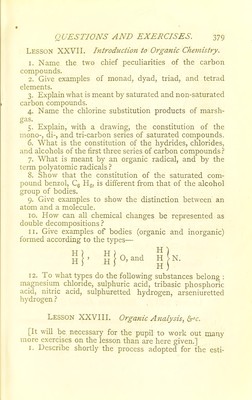
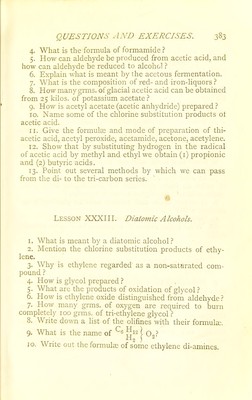
![LESSON XXVII. Introduction to Organic Chemistry. 1. Name the two chief peculiarities of the carbon compounds. 2. Give examples of monad, dyad, triad, and tetrad elements. 3. Explain what is meant by saturated and non-saturated carbon compounds. 4. Name the chlorine substitution products of marsh- 5. Explain, with a drawing, the constitution of the mono-, di-, and tri-carbon series of saturated compounds. 6. What is the constitution of the hydrides, chlorides, and alcohols of the first three series of carbon compounds ? 7. What is meant by an organic radical, and by the term polyatomic radicals ? 8. Show that the constitution of the saturated com- pound benzol, C6 HG; is different from that of the alcohol group of bodies. 9. Give examples to show the distinction between an atom and a molecule. 10. How can all chemical changes be represented as double decompositions ? 11. Give examples of bodies (organic and inorganic) formed according to the types— 12. To what types do the following substances belong : magnesium chloride, sulphuric acid, tribasic phosphoric acid, nitric acid, sulphuretted hydrogen, arseniuretted hydrogen ? Lesson XXVIII. Organic Analysis, &c. [It will be necessary for the pupil to work out many more exercises on the lesson than are here given.] 1. Describe shortly the process adopted for the esti- gas. H H O, and](https://iiif.wellcomecollection.org/image/b21927972_0397.jp2/full/800%2C/0/default.jpg)