Licence: Attribution 4.0 International (CC BY 4.0)
Credit: The resolution of benzoyloscine / by Frank Tutin. Source: Wellcome Collection.
Provider: This material has been provided by The Royal College of Surgeons of England. The original may be consulted at The Royal College of Surgeons of England.
4/8 page 1794
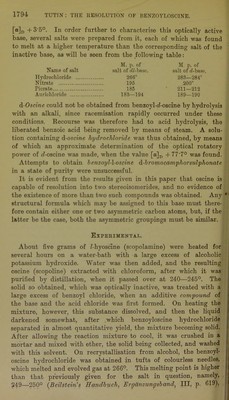
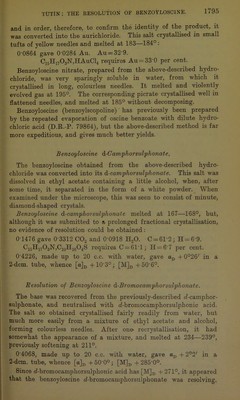
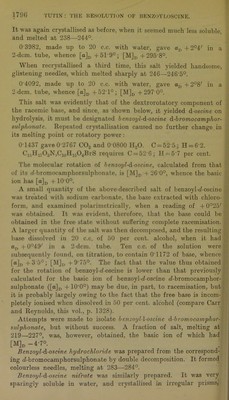
![[a]D + 3'5°. In order further to characterise this optically active base, several salts were prepared from it, each of which was found to melt at a higher temperature than the corresponding salt of the inactive base, as will be seen from the following table: M. p. of M p. of Name of salt salt of dl-base. salt of rf-baso. Hydrochloride 266° 288—284° Nitrate 195 200° Picrate 185 ' 211—212 Anrichlorido 188—194 189—190 d-Oscine could not be obtained from benzoyl-d-oscine by hydrolysis with an alkali, since racemisation rapidly occurred under these conditions. Recourse was therefore had to acid hydrolysis, the liberated benzoic acid being removed by means of steam. A solu- tion containing d-oscine hydrochloride was thus obtained, by means of which an approximate determination of the optical rotatory power of rf-oscine was made, when the value [a]D +77'7° was found. Attempts to obtain henzoyl-l-oscine d-bromocamphorsulphonate in a state of purity were unsuccessful. It is evident from the results given in this paper that oscine is capable of resolution into two stereoisomerides, and no evidence of the existence of more than two such compounds was obtained. Any structural formula which may be assigned to this base must there- fore contain either one or two asymmetric carbon atoms, but, if the latter be the case, both the asymmetric groupings must be similar. Experimental. About five grams of Miyoscine (scopolamine) were heated for several hours on a water-bath with a large excess of alcoholic potassium hydroxide. Water was then added, and the resulting oscine (scopoline) extracted with chloroform, after which it was purified by distillation, when it passed over at 240—245°. The solid so obtained, which was optically inactive, was treated with a large excess of benzoyl chloride, when an additive compound of the base and the acid chloride was first formed. On heating the mixture, however, this substance dissolved, and then the liquid darkened somewhat, after which benzoyloscine hydrochloride separated in almost quantitative yield, the mixture becoming solid. After allowing the reaction mixture to cool, it was crushed in a mortar and mixed with ether, the solid being collected, and washed with this solvent. On recrystallisation from alcohol, the benzoyl- oscine hydrochloride was obtained in tufts of colourless needles, which melted and evolved gas at 266°. This melting point is higher than that previously given for the salt in question, namely, 249—250° (Beilstein’s Handbucli, Eryttnzungsband, III, p. 619);](https://iiif.wellcomecollection.org/image/b22433144_0006.jp2/full/800%2C/0/default.jpg)
 No text description is available for this image
 No text description is available for this image
 No text description is available for this image