[Report 1922] / Medical Officer of Health, Salop / Shropshire County Council.
- Shropshire Council
- Date:
- 1922
Licence: Attribution 4.0 International (CC BY 4.0)
Credit: [Report 1922] / Medical Officer of Health, Salop / Shropshire County Council. Source: Wellcome Collection.
7/50 (page 6)
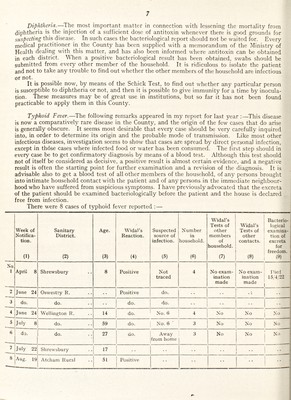
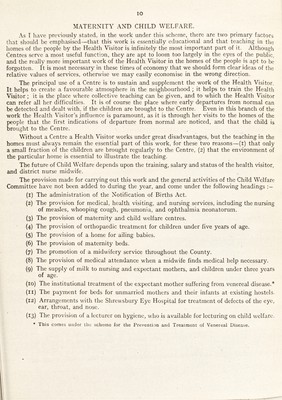
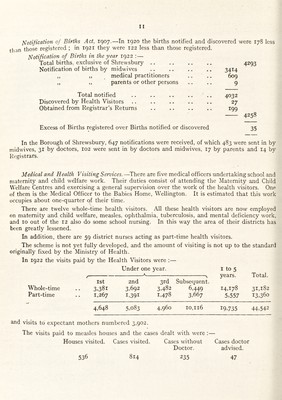
![Tho decrease of infant mortality in Urban and Rural Districts as shown in this tabic is extremely interesting and will afford data for checking our work. The high mortalities appear to follow very often on previous low mortalities and consequently one has to be careful in drawing inferences from single years. ^larket Drayton Urban District had the highest rate for 1922. This District has had a consistently high rate since its formation. It is satisfactory that a Child Welfare Centre has now been established in this district. INFECTIOUS DISEASE. There was nothing in the shape of a serious epidemic of infectious disease during the year, although in a few districts there was more than the usual prevalence of scarlet fever and diph¬ theria. The action of health authorities has in the past been directed principally against the common infectious diseases, particularly the notifiable diseases, to the exclusion of much more effective action in other directions. ]\Iany of these diseases such as typhus fever and cholera are now non-existent in this country ; others, such as typhoid fever and (judged by death-rates), scarlet fever also, have been reduced to negligible quantities. It is true that scarlet fever, unlike typhoid fever, may, for anything we know, become prevalent and malignant again at some future time but this does not appear likely. The death-rate from diphtheria would also be reduced almost to the vanishing point if we could ensure the injection of a sufficient dose of antitoxin at the onset of the illness. There remain the two diseases—measles and whooping cough—which are responsible directly and indirectly, for most of the deaths due to the ‘common’ infectious diseases. In dealing with infectious diseases the means to be employed and the results that can be expected differ widely^ Typhoid fever must be attacked principally by protecting our food and water supplies and general sanitation, and will by these means be finally eliminated. Small- po.x can be absolutely controlled by vaccination and isolation. The group of diseases spread mostly by throat and nose carriers, including scarlet fever, diphtheria, cerebro-spinal fever, pneumonia, influenza and probably poliomyelitis and encephalitis lethargica, are most difficult to control. In these diseases isolation of the known case is often of little avail, because the unsuspected cases or carriers continue to spread the disease. These diseases, together with measles and whooping cough, can probably best be reduced and rendered less fatal by improving ventilation and cleanliness, by lessening overcrowding of homes, schools and workplaces, and by provading skilled health visiting and nursing in the homes. Education of the people in the nature of infection, how it is spread, how the danger of spread can be lessened and in the general hygienic principles that should be observed when the disease is contracted, is the most hopeful way of dealing with this class of infectious disease. Small-pox.—No case of small-pox was notified during the year. The number of unvaccinated persons in the county must now be very large, and consequently if cases of small-po.x are intro¬ duced, we shall have to depend upon prompt isolation of the cases, and supervision and vaccina¬ tion of contacts. Hospital isolation is provided by the County Council for all districts except the Boroughs of Shrewsbury and Wenlock and the rural district of Teme, and all arrangements have been made for the prompt removal of patients to a hospital.](https://iiif.wellcomecollection.org/image/b30086607_0009.jp2/full/800%2C/0/default.jpg)