Tables of physical and chemical constants and some mathematical functions / by G.W.C. Kaye and T.H. Laby.
- G. W. C. Kaye
- Date:
- 1911
Licence: Public Domain Mark
Credit: Tables of physical and chemical constants and some mathematical functions / by G.W.C. Kaye and T.H. Laby. Source: Wellcome Collection.
16/172 page 4
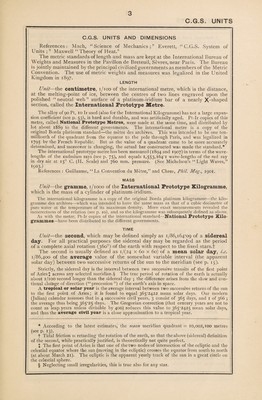
![BRITISH UNITS A sidereal year is the time interval in which the sun appears to perform a complete revolu¬ tion with reference to the fixed stars ; i e. it is the time in which the earth describes one sidereal revolution round the sun. Owing to precession, a sidereal year is longer than a tropical year. h. m. s. Mean solar day = 24 o o = 86,400 secs. Sidereal day = 23 56 4-0906 = 86,164 0906 secs. Tropical year = 363-2422 mean solar days. Sidereal year = 365-2564 „ ,, ,, (epoch 1900). = 366-2564 sidereal days. Reference : Newcomb, “ Astronomy.” BRITISH IMPERIAL STANDARDS. (From information supplied by Major MacMahon, F.R.S., Board of Trade, Standards Office.) According to the Weights and Measures Act, 1878, the yard is the distance, at 62° F., between the central transverse lines in two gold plugs in the bronze bar, called the Imperial Standard Yard, when supported on bronze rollers in such manner as best to avoid flexure of the bar. The defining lines are situated at the bottom of each of two holes, so as to be in the medium plane of the bar, which is of 1 inch square section and 38 inches long. Its composition is 32 Cu, 5 Sn, 2 Zn. Copper alloys are now known not to be suitable for standards of length, and in 1902 a Pt-Ir X-shaped copy of the yard was made. The pound is the weight in vacuo of a platinum cylinder called the imperial standard pound. The imperial standard yard and pound are preserved at the Standards Office of the Board of Trade, Old Palace Yard. A number of official copies have been prepared, and are in the custody of the Royal Society, the Mint, Greenwich Ob¬ servatory, and the Houses of Parliament. The gallon contains 10 lbs. weight of distilled water weighed in air against brass weights at a pressure of 30 inches, and with the water and the air at 62° F. [Note.—No mention is made in the Act of the density of the brass weights, or of the humidity of the air.] BRITISH AND METRIC EQUIVALENTS The present legal equivalents are those legalized by the Order in Council of May 19, 1898, and derived at the International Bureau of Weights and Measures, by Benoit in 1895 in the case of the yard and the metre, and by Broch in 1883 for the pound and the kilogramme. (See Trav. et Mem. du Bur. Inti., tomes iv., 1885, and xii., 1902.) Imperial Standard. International Prototype. (Reciprocal.) 1 yard = '914399 metre 1-093614 1 pound = *45359-43 kilogramme 2*2046223 [Note.—The yard is defined at 62° F., the metre at o° C.] DERIVED C.G.S. UNITS AND STANDARDS GENERAL AND MECHANICAL UNITS Area :—Unit—the square centimetre. Volume :—Unit—the cubic centimetre (c.c.). The metric unit is the litre, now defined as the volume of a kilogramme of pure, air-free water at the tem¬ perature of maximum density (see p. 22) and 760 mm. pressure (.Proces Verbaux, 1901, p. 175). The litre was originally intended to be 1 cubic decimetre or 1000 c.cs. ; the present accepted experimental relation is that 1 kilogramme of water at 40 C. and 760 mm. pressure measures 1000-027 c.cs. (see p. 10). Density :—Unit—grammes per c.c. Specific gravity expresses the density of a substance relative to that of water, and is objectionable in requiring two tem¬ peratures to be stated.](https://iiif.wellcomecollection.org/image/b3135578x_0016.jp2/full/800%2C/0/default.jpg)




 No text description is available for this image
 No text description is available for this image
 No text description is available for this image