Volume 1
A student's text-book of zoology / by Adam Sedgwick.
- Sedgwick, Adam, 1854-1913.
- Date:
- 1898-1909
Licence: In copyright
Credit: A student's text-book of zoology / by Adam Sedgwick. Source: Wellcome Collection.
112/640 (page 96)
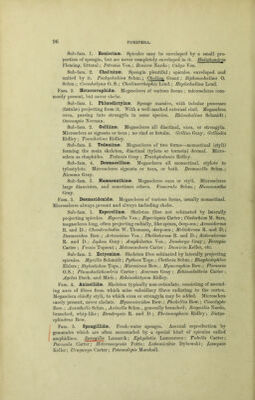
![Sub-fani. 1. Renierinae. Spicules may be enveloped by a small pro- })ortion of spongin, but are never completely enveloped in it. Halichondria Fleming, littoral; Petrosia Vos.; Reniera Nardo ; Calyx Vos. Sub-fam. 2. Chalininae, Spongin plentiful; spicules enveloped and united by it. Pacliychalina Schm.; Chalina Grant; Siphmiochalina 0. Scbm.; Cncochalij7ia 0. S.; Chalinoi'rhaphis Ijend.; Roplochalina hend. Fam. 2. Heterorraphidse. Megascleres of various forms ; microscleres com- monly present, but never chelse. Sub-fam. 1. Phloeodictyinae. Sponge massive, with tubular processes (fistulse) projecting from it. With a well-marked external rind. Megasclera oxea, passing into strongyla in some species. Rhizochalina Schmidt; Oeeanapia Norman. Sub-fam. 2. Gelliinae. Megascleres all diactinal, oxea, or strongyla. Micro.sclera as sigmata or toxa ; no rind or fistulie. Oellius Gr&y ■, Gelliodcs Ridley ; Toxochalina Ridley. Sub-fam. 3. Tedaniinae. Megascleres of two forms—monactinal (styli) forming the main skeleton, diactinal (tylota or tornota) dermal. Micro- sclera as rhaphides. Tcdania Gray ; Trachytedania Ridley. Sub-fam. 4. Desmacellinae. Megascleres all monactinal, stylote to tylostylote. Microscleres sigmata or toxa, or both. Desmacclla Schm.; Bicmma Gray. Sub-fam. 5. Hamacanthinae. Megascleres oxea or styli. Microscleres large diancistra, and sometimes others. Vomcrula Schm.; Hamacantha Gray. Fam. 3. Desmacidonidae. Megascleres of various forms, usually monactinal. Microscleres always present and always including chelae. Sub-fam. 1. Esperellinae. Skeleton fibre not echinated by laterally projecting spicules. Espei'clla Vos.; Esperiopsis Carter; Cladorhiza M. Sars, megascleres long, often projecting radially, like spines, deep-sea; Axoniderma R. and D.; Chondrocladia W. Thomson, deep-sea ; Meliidcrma R. and D.; Desmacidon Bow.; Artemisma Yos.; Phelloderma R. and D.; Siderodcrma R. and D.; lophon Gray; Amphiledus Vos.; Dendoryx Gray; Forccpia Carter ; Yvesia Toj)sent; Mctonanchora Carter ; Bainiria Keller, etc. Sub-fam. 2. Ectyoninse. Skeleton fibre echinated by laterally projecting spicules. Myxilla Schmidt; Pytheas Tops.; Clathria Schm.; Rhaphidophlus Fillers; StylostichonYo])s.-, MicrocionaP>o\w, ITymeraphia Bow. •, Plocmnia O.S.; Plumohalichondria Carter; Acarnus Gray; Echinoclathria Carter; Agclas Duch. and Mich.; Echmodictyum Ridley. Fam. .4. Axinellidae. Skeleton typically non-reticulate, consisting of ascend- ing axes of fibres from which arise subsidiary fibres radiating to the cortex. Megasclera chiefiy styli, to which oxea or strongyla may be added. Microsclera rarely present, never chelate. Uijme^dacidon Bow.; PhaJcellia Bow.; Ciocalypta Bow.; Acanthella Schm., Axinella Schm., generally branched ; Rtcspailia'Na.rdo, branched, whip-like; Dendrop>sis R. and D.; Thi'inacoplioi'a Ridley; Dictyo- cylindrus Bow. Fam. 5. Spongillidse. Fresh-water sponges. Asexual reproduction by gemmules which are often surrounded by a special kind of spicules called amphidisos. Spongilla Lamarck; Ephydatia Lamouroux: Tuhella Carter; Parmula Carter; Hctcroineymia Potts; Lubomirskia Dybowski; Lessepsia Keller; Uruguaya Carter; Potainolcpis Marshall.](https://iiif.wellcomecollection.org/image/b28121223_0001_0112.jp2/full/800%2C/0/default.jpg)