Volume 3
A student's text-book of zoology / by Adam Sedgwick.
- Sedgwick, Adam, 1854-1913.
- Date:
- 1898-1909
Licence: In copyright
Credit: A student's text-book of zoology / by Adam Sedgwick. Source: Wellcome Collection.
39/930 (page 19)
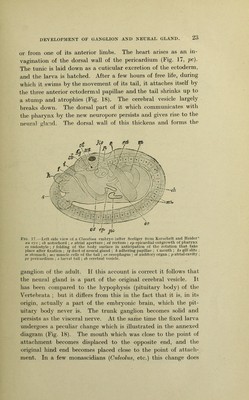
![to tlie accounts given below under each family or order. Here we will only remark that there is considerable variability in the mode of formation of the organs. The pharynx, atrium, diges- tive organs and pericardium are usually derived from the epi- cardial process of the pharynx, while the ganglion in the synascidians usually develops from the endoderm, but it may arise from the mesoderm (Pyrosoma) or from the ectoderm (Thaliacea). In the Botryllidae the endoderm of the parent does not participate in the budding process. Development. In most monascidians (except Cynthia, etc.) the eggs are fertilised in the sea or in the atrium and undergo their whole development outside the body of the parent. This is also the case in Doliolum and in the Appendiculariae. In the synascidians on the other hand the early development usually takes place in the atrial cavity or in incubatory pouches of it. In the salps the egg undergoes its early development in the ovary ; in the later stages it emerges into the atrial cavity but remains connected with the parent by the placenta The eggs are frequently laid in their follicle, which is somewhat com- plicated. It is formed of two layers (Fig. 14), the outer of which consists of vacuolated cells ; these are prolonged into papillae, and help to float the egg in the sea. The inner layer consists of follicle-cells which have migrated inwards, and are called the test-cells because formerly they were supposed to give rise to the test of the adult. The two layers are separ- ated by a structureless chorion. The development generally leads to' the formation of a free-swimming tailed larva, the tadpole larva, by means of which the species is distributed over a wider area. The tad- ]3ole larva is nearly always formed in the monascidians (it is absent in some species of Molgula) and in the synas- cidians (absent in Pyrosoma). It is also found in Doliolum, but not in the salps. The eggs usually have but little yolk. In the synascidians they are however richer in yolk, and in Pyrosoma the cleavage is actually meroblastic Fig. 14.—Mature egg from the oviduct of Ciona iniestinalis (after Kupffer). c follicle cells (foam-like cells) ; d chorion ; e test-cells ; / ovum : X gelatinous substance.](https://iiif.wellcomecollection.org/image/b28121223_0003_0039.jp2/full/800%2C/0/default.jpg)