Report of the Royal Commission on the Aged Poor, appointed to consider whether any alterations in the system of Poor Law Relief are desirable, in the case of persons whose destitution is occasioned by incapacity for work resulting from old age, or whether assistance could otherwise be afforded in those cases. Vols I - III [Minutes of evidence taken before the Royal Commission on the Aged Poor. Days 1 to 26. Vol. II.-- Minutes of evidence taken before the Royal Commission on the Aged Poor. Days 27 to 48. With appendix and index. Vol. III.].
- Great Britain. Royal Commission on the Aged Poor
- Date:
- 1895
Licence: Public Domain Mark
Credit: Report of the Royal Commission on the Aged Poor, appointed to consider whether any alterations in the system of Poor Law Relief are desirable, in the case of persons whose destitution is occasioned by incapacity for work resulting from old age, or whether assistance could otherwise be afforded in those cases. Vols I - III [Minutes of evidence taken before the Royal Commission on the Aged Poor. Days 1 to 26. Vol. II.-- Minutes of evidence taken before the Royal Commission on the Aged Poor. Days 27 to 48. With appendix and index. Vol. III.]. Source: Wellcome Collection.
Provider: This material has been provided by London School of Hygiene & Tropical Medicine Library & Archives Service. The original may be consulted at London School of Hygiene & Tropical Medicine Library & Archives Service.
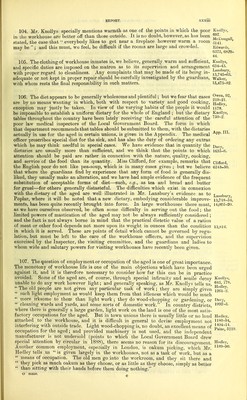
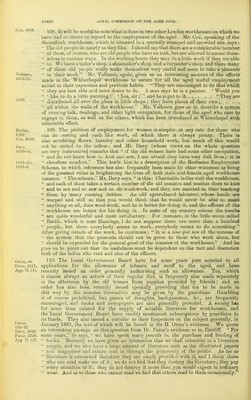
![96. The regulations as to life in workhouses, and the conditions under which they Owen, are managed, have been fully set before us in the evidence of Sir H. Owen and Mr. ^^^^jf^g Knollys, and in the extracts from the Consolidated Order of 1847, which are printed 612-78.' in the Appendix. We have had detailed particulars as to classification, discipline, App. I. diet, medical attendance and nursing, employment or occupation, amusements, visits of friends and leave of absence, visits by guardians and ladies, &c.; and the general information given to us on these subjects has been widely illustrated by reference particular workhouses in various parts of th^cQjm^^y, .^, ,io:«MJD<n> ev. u ifeiia '<jl^ 97. We feel bound to say at once that the general impression made upon our minds Marshall, by the evidence we have received does not support the views which some witnesses 1^263' have told us are entertained of workhouses and their conditions, as being barbarous ^dVards tests, worse than prisons, places which the^' poor -vrould ' rather' Starve than enter, 6570-.S. maddening to the decent deserving poor;'' As against'such terms of denunciation Wilkinson, we may quote the views expressed by that eminent German critic, Dr. Aschrott, who as gQ^^'g Mr. Davy tells us caJne absolutely unprejudiced to the observation of English work- Blackle'y, houses. The management of the workhouses, he says, is a model of imitation i2,852, AH the legitimate wants are amply satisfied without disregard for the necessity for Pickering, careful and economical administration. The proper mean is preserved between the |^'y^^^g82 humanitarian indulgence and the stringency demanded by the interests of the commu- nity. There is,however, undoubtedly a wide-spread dislike among the poor to entering the workhouse, and nearly every working class witness testified to the great repug- Lansbury, nance with which it is viewed by the better class of aged poor, especially in country p^^^f^^^ districts. While they regard it as not unsuitable for wastrels and ne'er-do-wells, or Caiiear,i4,876 indeed'a-s much better than they deserve, they contend that outdoor relief should ^^t^'15Icq be given to the honest hard-working man who becomes destitute in consequence of Ward' is'eso age and infirmity. We believe that this marked dislike of the workhouse is larsfelv Burton, 16,072 due to a praiseworthy repugnance to the reception of public aid in a form which dannot i6,4i8; Disiej-,' be disguised, and to the dread of having to associate with disreputable companions, stevens 17 26i- But we are convinced that it may also be often attributed to ignorance and misappre- Crompton,' hension of the conditions, and to exaggerated fear of the discipline and the interference i7,364. with absolute freedom which are imperative in such establishments; and we note that some of the witnesses who are strongest in favour of extended outdoor relief admit that they have never been inside the workhouses which they condemn. 98. Many, however, of the witnesses representing the working classes who have appeared before us have spoken with approval of the treatment accorded to the poor in workhouse establishments of which they have any knowledge; we may refer especially to the evidence of Mr. Burton and Mr. Disley as to the Ashby and Torden workhouses, Enrton, and of Mr. Allen, Mr. Jephcott, and Mr. Stevens, who all agree in praising the adminis- 16,03G-7o. tration of the Birmingham workhouse and infirmary. On the other hand, we have J7'o]4_8 had complaints of bad management and harsh treatment, to some of which we shall ' make further reference, and we fear that there are still not a few workhouses in the country in which there is much room for improvement. A certain number of specific charges of individual misconduct or mismanagement, whether in connexion with work- houses or the general administration of the Poor Law, have been made to us by witnesses in the course of our inquiry. We do not wish to minimise these complaints, but we cannot avoid pointing out, in justice to boards of guardians and their ofiicers, that we have received such statements as indicating the opinions of those by whom they have been made, without attempting any such judicial investigation, based on a full hearing of both sides, as would alone justify us in forming definite conclusions as to their accuracy. It appeared to us that investigations of this kind would be both unsuited to the conditions, and foreign to the purpose of our inquiry. 99. Miss Octavia Hill has given evidence as to the provision made for the indoor Hill, poor which may well be quoted here. I suppose, she says, workhouses difier 10,658-60. a good deal, but I have very often heard the poor, after they have gone in, express themselves most delighted with the arrangements, and certainly for a very large number of old people the workhouse is the best place. It is very difficult to provide satisfactorily for a single old persoi^ in an ordinary London house. There are dangers of fire, of dirt, of loneliness . . . When they get old or feeble they are often not able to take care of themselves thoroughly, and it is a most d 4](https://iiif.wellcomecollection.org/image/b24399498_0039.jp2/full/800%2C/0/default.jpg)
 No text description is available for this image
 No text description is available for this image
 No text description is available for this image