Report of the Medical Officer of Health / Municipality of Colombo.
- Colombo (Sri Lanka). Public Health Department
- Date:
- [1921]
Licence: Public Domain Mark
Credit: Report of the Medical Officer of Health / Municipality of Colombo. Source: Wellcome Collection.
10/80 page 8
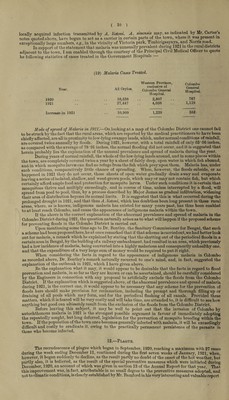
![(18) Enteric Cases reported during 1921 (inclusive of Port and Outside Cases). Distribution by Race, Age, and. Sex. 0 o o O o 3 © © Race. Sex. OQ G 03 OQ M <£ QQ P c3 £ . QQ P cS £ S <S £ s' C3 ® s' <3 $ OQ P c3 0 CQ c <3 s' c3 © P <D > « ,4 o c3 ® L, o © • rH >> P »H (3 43 t g *4 .2 C, 3 >>’3 O O O rH o lO pH o p o <N O P o p o CO o -p o CO o p © o •*3 o to o p o CD O P o TJ § OQ* 0 w> <1 P o c6 p <$ CL, £ OQ* rS P c3 s£ .12 a © o 03 q. -e* o P o p K) o fH IQ r-H o di (M o CO iO CO o O iO o CD < H c8 O ft c8 O § All Races . Males Females 8 8 30 20 41 49 52 34 74 28 52 33 32 14 18 12 27 17 9 6 3 5 346 226 J 572 2-34 219 38-3 0-90 Europeans Males [Females — _ _ 1 2 1 — 1 2 3 1 2 1 1 - - - 9 6 * 15 4-86 4 26-7 1*30 Burghers.. [Males Females 1 4 3 1 7 3 3 6 2 2 5 2 3 2 3 2 6 2 1 1 1 34 26 J 60 4-12 18 30-0 1 23 Sinhalese. . Males Females 6 3 22 14 30 37 36 24 49 21 29 26 20 8 5 7 16 13 6 5 1 3 220 161 ] 381 3-34 144 37-8 1-26 Tamils Males [^Females 1 2 3 2 3 8 7 1 4 1 1 2 4 1 2 1 ‘ 2 1 33 13 ] 46 0-84 19 41-2 0-35 Moors [Males Females 1 2 1 5 1 3 5 2 5 2 3 1 1 1 — 19 14 33 0*88 20 60-6 0-50 Malays Males [Females' — 1 1 1 1 . 1 2 ' 1 — — — 3 5 8 1-36 2 25-0 0-34 Others Males Females — — 1 4 9 8 4 2 28 1 29 2-62 12 41-3 1-09 (6) Malaria.—With the exception of a somewhat severe, but strictly localized outbreak of locally- acquired malaria, which occurred at Fisher’s quarters, Mutwal, in 1903-04, and which was traced to the breeding of large numbers of Anopheles culicifacies in the Government quarry, Colombo has hitherto been justly regarded as being practically free from indigenous malaria. The discovery and abolition of the breeding places of these mosquitoes in 1904 quickly brought that outbreak to an end. Anopheles mosquitoes in Colombo.—Major (now Lieut.-Colonel) James, I.M.S., who carried out a very comprehensive and thorough mosquito survey of Colombo in 1913, recorded the finding of eight different species of anopheles in the town; but stated that none of these appeared to be present in sufficient numbers to cause an outbreak of malaria. He specially mentions the fact that he did not find either A. culicifacies, which is the chief malaria carrier in some parts of India and in the northern part of Ceylon, or A. maculatus, another well-known malaria carrier in India, Malaya, and China, and which is abundant on tea estates in hilly districts in Ceylon. The species of anopheles, recorded by Major James, in Colombo are :— 1. A. rossii 3. A. barbirostris 5. A. tessalatus 2. A. jamesii 4. A. fuliginosus 6. A. albirostris 7. A. ludlowii 8. A. sinensis of these, rossii, jamesii, and barbirostris are stated by Major James to be the most numerous, none of which, however, are so far as is known, carriers of malaria in nature ; fuliginosus is a known carrier, but seems to be too scarce here to be of much importance ; tessalatus, which is said to be an important carrier in Malaya and NewGuinea, has been found breeding over a fairly wide area in Colombo ; not very much is, however, known about its habits; albirostris, or minimus var. aconitus, which is an important carrier in Malaya andChina, does not appear to be common here,and has not recently been found by us; ludlowii, which is an important malaria carrier in the Andaman Islands, Malaya, and the Dutch East Indies, is peculiar, in that it breeds freely in brackish or even in highly concentrated sea water ; it used to be found breeding in the salt water rock pools at Galle Buck and occasionally in the bilge water of barges in the harbour, but it has not recently been found by us in Colombo ; sinensis : This anopheles has long been known in Colombo, having, in common with barbirostris, rossii, and others, been found by me in 1904 in practically all the swamps in Colombo. It has not, however, been found prior to 1921, except in small numbers, and it has not hitherto been regarded as a probable malaria carrier here ; its distribution here has certainly not been associated with the occurrence of indigenous malaria hitherto. During 1921, however, it was found by us breeding in extraordinarily large numbers in certain parts of the town, notably in the pond for aquatic plants within the Victoria park gardens, in various trenches and ditches near Guildford crescent, in a trench at Jawatta road, in the Dehiwala canal, in the Forbes road swamp, and in the lake reclamation opposite Norris road. As its prevalence and distribution in 1921, coupled with the occurrence of indigenous malaria, raised the suspicion that it might now be carrying malaria here, I consulted Mr. Henry F. Carter, the Government Malariologist, who kindly furnished me with the following notes in regard to this mosquito, and also very kindly offered to undertake dissections of the insect, with a view to discovering whether it was connected in anyway with malaria here. So far, however, we have been unable, owing to the abolition of all its breeding places in the infected parts of the town, to obtain specimens suitable for examination in this connection. Mr. Carter’s Notes. “ Until quite recently it has been considered that A. sinensis (although known to be capable of harbouring the parasites) was of very little importance as a natural carrier of malaria. But in view of Walch’s paper (referred to in the above account) it would appear that in certain circumstances, and when present in large numbers, this species may be an active agent in transmission.](https://iiif.wellcomecollection.org/image/b31495205_0010.jp2/full/800%2C/0/default.jpg)


 No text description is available for this image
 No text description is available for this image
 No text description is available for this image