Volume 1
Special pathology and therapeutics of the diseases of domestic animals / by Franz Hutyra and Josef Marek.
- Hutyra, Ferenc, 1860-1934.
- Date:
- 1916-1917
Licence: Public Domain Mark
Credit: Special pathology and therapeutics of the diseases of domestic animals / by Franz Hutyra and Josef Marek. Source: Wellcome Collection.
36/1262 page 16
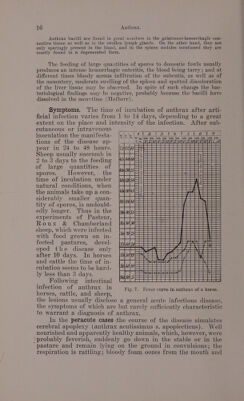
![Anthrax bacilli are found in great numbers in the gelatinous-hemorrhagic con- nective tissue as well as in the swollen lymph glands. On the other hand, they are © only sparingly present in the blood, and in the spleen nodules mentioned they are mostly found in a degenerated form. The feeding of large quantities of spores to domestic fowls usually produces an intense hemorrhagic enteritis, the blood being tarry; and at different times bloody serous infiltration of the subeutis, as well as of the mesentery, moderate swelling of the spleen and spotted discoloration of the liver tissue may be observed. In spite of such changs the bac- teriological findings may be negative, probably because the bacilli have dissolved in the meantime (Hofherr). Symptoms. The time of incubation of anthrax after arti- ficial infection varies from 1 to 14 days, depending to a great extent on the place and intensity of the infection. After sub- cutaneous or intravenous oon inoculation the manifesta- ni “Z1_2 | 3 1 4 4 3 (ee siderably smaller quan- é . P P jam _pm jam pm tions of the disease ap- BANANA aTUCE AEE pear in 24 to 48 hours. =seeses==2====55= Sheep usually suecumb in SSfSSsSase=ecs 2 to 3 days to the feeding toy om bo os ew pat betes of large quantities of Podesta dda fod eta = aoa spores. However, the Soe eee on eee eer ec time of incubation under See ee hie natural conditions, when Smteoresescea a Ge oh the animals take up a con- ttt ‘Ses oes totes Pe. a = = tity of spores, is undoubt- edly longer. Thus in the MI WT = J = 4 = = el ; re muses mar = experiments of Pasteur, = isu eal bes Sot sens ee Roux & Chamberland = SSeS sheep, which were infected = S=sces sees == Se Sen Toa eo ae eae eeeeas Saaeee a= 8 : SSSS eases eae fected pastures, devel- = KAA oped the disease only PAN AR after 10 days. In horses (jms ee ee and eattle the time of in- =o at A 2sSsecsaa cubation seems to be hard- Zen l= Sees] Zanene Ss. i Dl Sal a Se ee | ed iat BE A AE ly less than 3 days. foo] 5 eee SSfnsae== Followine intestinal a eal Gl ee A et sts ec a males SS e . —) 1 . infection of anthrax in Fig. 7. Fever curve in anthrax of a horse. horses, cattle, and sheep, the lesions usually disclose a general acute infectious disease, the symptoms of which are but rarely sufficiently characteristic to warrant a diagnosis of anthrax. In the peracute cases the course of the disease simulates cerebral apoplexy (anthrax acutissimus s. apoplecticus). Well nourished and apparently healthy animals, which, however, were _probably feverish, suddenly go down in the stable or in the pasture and remain lying on the ground in convulsions; the respiration is rattling; bloody foam oozes from the mouth and](https://iiif.wellcomecollection.org/image/b32763499_0001_0036.jp2/full/800%2C/0/default.jpg)

 No text description is available for this image
 No text description is available for this image
 No text description is available for this image