Statistical reports on the sickness, mortality, & invaliding, among the troops in Western Africa, St. Helena, the Cape of Good Hope, and the Mauritius; : prepared from the records of the Army Medical Department and War-Office returns [by A.M. Tulloch, H. Marshall and T.G. Balfour]. / Presented to both Houses of Parliament by command of Her Majesty.
- Great Britain. Army Medical Services
- Date:
- 1840
Licence: Public Domain Mark
Credit: Statistical reports on the sickness, mortality, & invaliding, among the troops in Western Africa, St. Helena, the Cape of Good Hope, and the Mauritius; : prepared from the records of the Army Medical Department and War-Office returns [by A.M. Tulloch, H. Marshall and T.G. Balfour]. / Presented to both Houses of Parliament by command of Her Majesty. Source: Wellcome Collection.
Provider: This material has been provided by London School of Hygiene & Tropical Medicine Library & Archives Service. The original may be consulted at London School of Hygiene & Tropical Medicine Library & Archives Service.
102/126 page 12
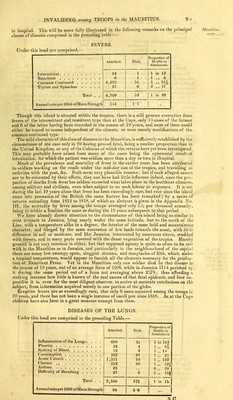
![Miiuril'ius. 'ngiiiwoiic n'T niuiii' ti-<i).if>M on ' the capital, most of wlilcli proved fatal in a few hours ; the epidemic soon became s^eneral throughout the island, and continued its ravages ainoiigall classes till the middle of February, after which it was principally confined to the bhick poj^ulation. The first case noticed among the troops was on the 30th of November, and the last on the 3rd of February. In the course of that period about 2 per cent, were cut off by it; the proportion of deaths to the number attacked was, during the first month of its prevalence, about 1 in 6, and during the second about 1 in the last cases which occurred in February were compaiativoly mild. The disease appears to have been little modified by locality, as the troops on the Windward and Leeward side of the isUmd suffered in iiearly an equal degree. At P<n-t Louis 13 died out of a strength of 601, and at Mahebourg and Flacq the same number out of a strength of G63; it was much more fatal, however, at Powder Mills, a spot always deemed insalubrious, as 6 died out of I.jO, and the cases were of so virulent a character that only 8 recovered out of 14 attacked. The disease exhibited nothinu of a conta'^ious charat-ter, even those who attended the sick were not more subject to it than others who had no intercourse with them. It did not affect all ranks equally, for among the civil population, the better classes of society siitl'ered comparatively little, and among the ofiicers no death took place, and only one was attacked. The total deaths recorded in the Civil and Military Hospitals, amounted to 1327, of whom 168 were whites, 162 coloured, and 'J'.)7 blacks, principalh' negroes, who seemed peculiarly subject to the disease, nearly 3 percent, of the whole number through- out the island having died from it. The greatest mortality within 24 hours was 52, and till the end of February the deaths averaged about 8 daily. The disease was tractablti when noticed in the earlier stages, but if neglected for a few hours, collapse took place, and there was httle prospect of recovery. On the whole, however, the proportion of deaths to admissions was considerably lower than on those recent occasions when it prevailed in the United Kingdom, Mediterranean, and America, as will be seen by the following com- parison :— J 1.1 the United Kingdom. Gibraltar . . . , Nova Scotia 1 in 31 3i In Canada 1 in 3 Honduras 1 3 the Mauritius 1 8-'- So that either the epidemic had been less severe in its character, or the remedies emploj'ed more successful. The weather for many months before this disease appeared was extremely variable aud unseasonable, the winds irregular, but more constantly from the eastward than had ever been observed before, there was less rain, and the mid-day heat is described as having been more oppressive, though the nights were colder than usual. It is worthy of remark, that the season at which the cholera appeared and continued its ravages, corresponds to the (I latter end of summer and autumn, during which that and other epidemics have generally been most prevalent in the northern hemisphere. This is not the only occasion on which cholera or some disease analogous in character, prevailed in the Mauritius, for in 177-5, after a long succession of dry weather, an epidemic exhibiting precisely the same symptoms broke out, and caused a very great mortality, par- o,;itlcularly among the negroes and coloured population. Of 4300 slaves belonging to Govern- ..;j,inent, more than 2000 are said to have been cut off by it, and those belonging to the planters suffered in nearly the same proportion. After it had raged for nearly two months, the island was visited by a severe hurricane, which is supposed to have put a stop to it, as very few cases occurred afterwards. ! DISEASES OF THE BRAIN. Under this class are comprised in the preceding Table,— )dj gnoaii Inflammation of tlie Brain . Headiiche Stroke of tlie sun , . . . Apoplexy Palsy Fatuity . Madness Epilepsy Braiu Fever of Dmukarus . Tolul . . . Annual ratio per 1000 of Mean Strennlh l'l'0|>UI 1 loll uf AdiiiitteJ. Died. Di.'iiiiis to Adini-sions. 41 5 1 in S 393 1 1 ., 393 23 1 1 „ rif) 30 l.'> 1 „ 2 6!) G 1 „ Ul IS) 1 1 „ 1!) 33 2 1 „ ]«.V 112 2 1 ., 5ft 514 50 1 „ 10] 1,236 S3 1 in 15 41 2-7 The ratio both of admissions and deaths from this class of diseases is unusually high, the ioruier being four times, the latter twice as much so as at the Cape, indeed, the adun'ssions occur in at least double the proportion of any other Colony. On inves;igation, however, we find that 303 cases reported as headache are stated to have been in most instances](https://iiif.wellcomecollection.org/image/b21365313_0102.jp2/full/800%2C/0/default.jpg)