Statistical reports on the sickness, mortality, & invaliding, among the troops in Western Africa, St. Helena, the Cape of Good Hope, and the Mauritius; : prepared from the records of the Army Medical Department and War-Office returns [by A.M. Tulloch, H. Marshall and T.G. Balfour]. / Presented to both Houses of Parliament by command of Her Majesty.
- Great Britain. Army Medical Services
- Date:
- 1840
Licence: Public Domain Mark
Credit: Statistical reports on the sickness, mortality, & invaliding, among the troops in Western Africa, St. Helena, the Cape of Good Hope, and the Mauritius; : prepared from the records of the Army Medical Department and War-Office returns [by A.M. Tulloch, H. Marshall and T.G. Balfour]. / Presented to both Houses of Parliament by command of Her Majesty. Source: Wellcome Collection.
Provider: This material has been provided by London School of Hygiene & Tropical Medicine Library & Archives Service. The original may be consulted at London School of Hygiene & Tropical Medicine Library & Archives Service.
14/126 (page 6)
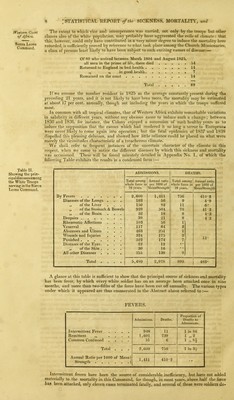
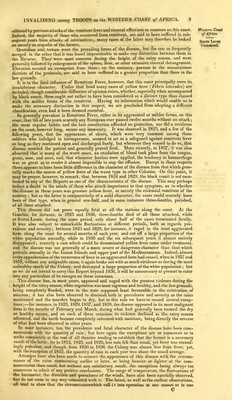
![Western Coait of Africa. Sierra Leone Command. Troops employed. Barracks and Hos- pitals. Rations and Diet. necessary to invigorate the body and give energy to the mind. At this period, the diseases which prove so iatal on the coast have generally made their appearance, though there have been so many exceptions, that they can scarcely be said to belong peculiarly to any season. During most oF the period under review the force consisted of a colonial corps of white and black troops, the former unfortunately of a class the least fitted to contend with such a climate, being principally soldiers allowed to volunteer their services as a commutation of punishment, and whose vices a«d intemperance, no doubt, in many instances facihtated the inroads of disease. Till 1817 the number of white and black soldiers was nearly equal, but in that year most of the former were removed to the frontier settlements of the Cape of Good Hope; and in 1819 the whole corps was disbanded and replaced by the 2nd West India Regiment, composed, with the exception of a few Serjeants, entirely of negroes. In 1823, however, a war having broke out with the Ashantees, the white soldiers formerly disbanded at the Cape of Good Hope were hastily re-embodied and sent to the defence of Cape Coast Castle ; the sur- vivors of these were subsequently transferred to the Sierra Leone Command, and, with several drafts of commuted punishment men from England, formed into the Royal African Colonial Corps, which thus again consisted of Europeans of the most degraded class. Death, however, thinned the ranks with such rapidity that an attempt had to be made, in 1825, to keep up the force by voluntary enlistment; above 100 recruits were in this manner raised and sent from Britain, but though their character and conduct appear to have been unexceptionable, they soon shared the same fate as their depraved comrades. The impossibility of main- taining white troops in such a climate being thus demonstrated, the garrison has, since the end of 1829, consisted entirely of blacks, wi^i the exception of a few European Serjeants. In a climate so remarkable for its insalubrity and the extreme inclemency of the rainy season, it was obviously essential to the health and efficiency of the troops that all the buildings occupied by them should be of the most substantial description. Such, however, was the state of decay and diUi])idation during the earlier years included in this Report, that, in 1821, the medical officer reported it was fortunate the troops were natives, for, had they been Europeans, he felt convinced the whole of them would be carried off in the course of twelve months; and fatally was this prediction verified, when, in 1824 and 1825, that description of force was employed w'ithout any improvement having been effected in this respect. Many of the officers even could then obtain no better accommodation than rude huts, incajiable of afiFording shelter from the inclemency of the rainy season, and in which it was not uncommon to find the husband, wife, and children lying in the last extremity of fever in the same room. It has been necessary to advert to this important fact, because, baneful as the climate of this colony unquestionably proves to the European constitution, even mider the most favourable circumstances, it would be improper to attribute the heavy loss sustained by the white troops to that cause alone, when it might, in some measure, have been induced by so powerful an accessory. At Sierra Leone, however, these defects were remedied in 1826, by the erection of new buildings, which are stated to be good, ample, and commodious. The barracks are situated on the svimmit of a conical hill 400 feet high, and nearly in the centre of the elevated range which surrounds Free Town. They consist of three large brick buildings, one for the officers, and two for the non-commissioned officers and privates; the latter are three stories high including the ground-floor, and are surrounded by a piazza ten feet broad. The hospital is a large stone building on the side of a hill, more elevated than any part of the town; it consists also of three stories including the ground-floor, with a piazza similar to the barracks, and, besides the surgery and requisite offices, contains two wards which afford accommodation for 44 patients. The barracks are supplied with water during one-half of the year from two large tanks or reservoirs, into which the rain flows from the roof of the buildings; during the rest of the year it is brought from a spring at the bottom of the hill on which the barracks stand. The hospital is also supplied from a spring about half a mile distant. Of the barracks at the Isles de Loss we can furnish no details; but the force stationed there has, of late years, been so small that the information is of little importance. The barrack at the Gambia is a substantial stone building, erected about 20 years ago, and said to be capable of affording accommodation for 150 men, but situated in the vicinity of the lowest ground in the island, where during the rains an extensive swamp is formed which, in the dry season, leaves the surface covered with a crust of sea-salt. The rooms are also stated to be very liable to damp, and their ventilation defective from the lowness of the site. The hospital enjoys a better position, and is said to be more than sufficient for the average number of patients, but regarding it we possess no specific details. Water is obtained from wells sunk in the barrack and hospital yard, but though in abundance, it is brackish, and liable to cause slight affections of the bowels in persons unaccustomed to it. There is no spring water of good quality to be obtained nearer than 15 miles. The barrack occupied by the detachment at M'Carthy's Island is merely part of a shed, in which the liberated Africans are lodged ; the hospital is on a ground-floor, with mud walls and thatched roof, and both buildings afford very insufficient accommodation, especially during the rainy season. The water is said to be of good quality. The ration of the soldier at present consists of 1 lb. of meat and 1 lb. of bread daily, for which he is subject to the regulated stoppage of bd. per day. Fresh meat is generally issued on five days in the week, and salt beef or pork on the other two. A good supply of coffee and rice is also obtained in addition to the rations for about 2c?. per day. Breakfast takes place at 8 A. M., and dinner at 1 p. m. The rations and diet are the same for the black as for the European troops. There is no regulated supper, but most of the negro soldiers are in the habit of providing themselves with a hot meal, which they take about sunset.](https://iiif.wellcomecollection.org/image/b21365313_0014.jp2/full/800%2C/0/default.jpg)