Statistical reports on the sickness, mortality, & invaliding, among the troops in Western Africa, St. Helena, the Cape of Good Hope, and the Mauritius; : prepared from the records of the Army Medical Department and War-Office returns [by A.M. Tulloch, H. Marshall and T.G. Balfour]. / Presented to both Houses of Parliament by command of Her Majesty.
- Great Britain. Army Medical Services
- Date:
- 1840
Licence: Public Domain Mark
Credit: Statistical reports on the sickness, mortality, & invaliding, among the troops in Western Africa, St. Helena, the Cape of Good Hope, and the Mauritius; : prepared from the records of the Army Medical Department and War-Office returns [by A.M. Tulloch, H. Marshall and T.G. Balfour]. / Presented to both Houses of Parliament by command of Her Majesty. Source: Wellcome Collection.
Provider: This material has been provided by London School of Hygiene & Tropical Medicine Library & Archives Service. The original may be consulted at London School of Hygiene & Tropical Medicine Library & Archives Service.
49/126 page 9
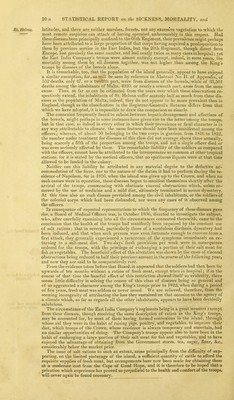
![DISEASES OF THE LIVER. St. Helena: Under this head are comprised in the preceding Table,— Acute Inflammation of Liver Chronic ,, Total . . . Annual Ratio per 1000 ofl Mean Strength . . . j Admissions. Deaths. ProportioTi of Deaths to Admissions. 102 63 6 10 14 1 in 10 1 „ 4} 0 „ 6 171 24 1 V 7 29 4 Like that of Western Africa.the climate of this island appears to exert an unfavourable influence on hepatic affections. They occur even more frequently and of a graver character than in the West Indies, though the temperature is lower and more uniform, and though other diseases are more rare. Their influence in this island, compared with temperate latitudes, maybe estimated from the fact, that of 5.52 deaths among the whole population, 16 were from diseases of the liver, being nearly 1 in 34^. Whereas in England, the Registrar-General's Returns show that of 148,70] deaths, only 1,909 were from the same class of diseases, being .... 1 in 78. Supposing the cjomposition of the population in regard to age, to be much the same in each, it may be iiiferred that diseases of the liver are more than twice as common in St, Helena as in England.. As the 1st Battalion of the 66th Regiment, which arrived from the East Indies in July 1817, brought with it many soldiers who, from previous service in that country, might have acquired a predisposition to hepatic diseases, we have, before venturing on these conclusions, been at some pains to ascertain whether that circumstance exerted any influence on the pre- vious results. On examining the Returns, however, that corps appears to have suffered less than the 20th which came direct from Europe, as of 22 deaths from hepatic di.sease prior to 1822, only 7 occurred in the former, while 15 took place in the latter during nearly the same period. Hepatic disease does not appear to have been by any means common among the military during the, last two years, but this may be merely a temporary suspensipn of its influence ; the results of several years at least, are requisite to found con- clusions on such a subject. We now come to a class of diseases, which have been the great source of the soldier's sufferings in this otherwise healthy climate, viz.— DISEASES OF THE STOMACH AND BOWELS. Under this class are comprised in the preceding Table,— ■ Admitted. Died. Proportion of i Deattis to 1 Admissions, j Abdominal Inflammation . 2 0 in 2 Inflammation of the Stomach. „ „ Bowels . . Vomitin;^ of Blood .... 4 12 1 705 46 18 19 412 338 27 2 5 64 5 3 3 1 „ 2 1 „ 2k 0 „ I 1 » 10^ 1 H 0 „ 18 0 „ 19 1 1 „ 137 0 „ 338 1 „ 9 Total .... 1,584 82 1 „ 15i Annual Ratio per 1000 of Meanl 268 13-9 More than a third of the admissions and nearly two-thirds of all the deaths among the troops, have been from this class of diseases. Dysentery is the prevailing form, and is evenmore severe than in the West Indies; yet in vain do we look for any pecuharity either in the climate or the locality to account for it;—the heat, owing to a cloudy sky and constant breeze, is far from oppressive, the range of the thermometer is extremely limited, and except occasionally in passing from the narrow and confined vallej's to the higher and more exposed parts of the island, sudden transitions of temperature are comparatively rare; the moisture, in the low grounds at least, where the troops are principally stationed, does not appear to have exceeded the usual average in similar 1 C](https://iiif.wellcomecollection.org/image/b21365313_0049.jp2/full/800%2C/0/default.jpg)


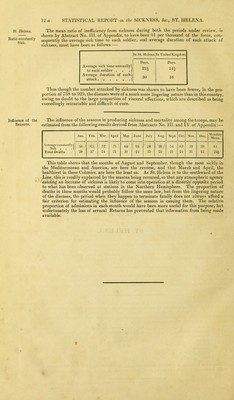

 No text description is available for this image
 No text description is available for this image
 No text description is available for this image