Statistical reports on the sickness, mortality, & invaliding, among the troops in Western Africa, St. Helena, the Cape of Good Hope, and the Mauritius; : prepared from the records of the Army Medical Department and War-Office returns [by A.M. Tulloch, H. Marshall and T.G. Balfour]. / Presented to both Houses of Parliament by command of Her Majesty.
- Great Britain. Army Medical Services
- Date:
- 1840
Licence: Public Domain Mark
Credit: Statistical reports on the sickness, mortality, & invaliding, among the troops in Western Africa, St. Helena, the Cape of Good Hope, and the Mauritius; : prepared from the records of the Army Medical Department and War-Office returns [by A.M. Tulloch, H. Marshall and T.G. Balfour]. / Presented to both Houses of Parliament by command of Her Majesty. Source: Wellcome Collection.
Provider: This material has been provided by London School of Hygiene & Tropical Medicine Library & Archives Service. The original may be consulted at London School of Hygiene & Tropical Medicine Library & Archives Service.
93/126 (page 3)
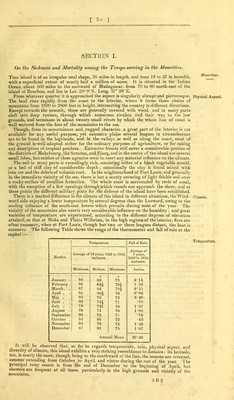
![[ 3c ] SECTION I. On the Sickness and Mortality among the Troops serving in the Mauritius. Mauritius. This island is of an irregular oval shape, SB miles in length, and from 18 to 27 in breadth, with a superficial extent of nearly half a million of acres. It is situated in the Indian Ocean, about 500 miles to the eastward of Madagascar, from 70 to 80 north-east of the island of Bourbon, and lies in Lat. 20° 9' S., Long. 57° 28' E. From whatever quarter it is approached the aspect is singularly abrupt and picturesque. Physical Aspect. The land rises rapidly from the coast to the interior, where it forms three chains of mountains from 1800 to 2800 feet in height, intersecting the country in different directions. Except towards the summit, these are generally covered with wood, and in many parts cleft into deep ravines, through which numerous rivulets find their way to the low grounds, and terminate in about twenty small rivers by which the whole line of coast is well watered from the foot of the mountains to the sea. Though, from its mountainous and rugged character, a great part of the interior is not available for any useful purpose, yet extensive plains several leagues in circumference are to be found in the highlands, and in the valleys as well as along the coast, most of the ground is well adapted either for the ordinary purposes of agriculture, or for raising any description of tropical produce. Extensive forests still cover a considerable portion of the districts of Mahebourg, the Savanna, and Flacq, and in the centre of the island are several small lakes, but neither of these agencies seem to exert any material influence on the climate. The soil in many parts is exceedingly rich, consisting either of a black vegetable mould, or a bed of stiff clay of considerable depth ; occasionally the clay is found mixed with iron ore and the debris of volcanic rock. In the neighbourhood of Port Louis, and generally in the immediate vicinity of the sea, there is but a scanty covering of light friable soil over a rocky surface of coralline formation. I'he whole coast is surrounded by reefs of coral, with the exception of a few openings through which vessels can approach the shore, and at these points the different military posts for the defence of the island have been established. There is a marked difference in the climate of this island in different situations, the Wind- Climate, ward side enjoying a lower temperature by several degrees than the Leeward, owing to the cooling influence of the south-east breeze which prevails during most of the year. The vicinity of the mountains also exerts very considerable influence on the humidity; and great varieties of temperature are experienced, according to the different degrees of elevation attained, so that at Moka and Plains Wilheims, in the high regions of the interior*, fires are often necessary, when at Port Louis, though but two or three leagues distant, the. heat is excessive. The following Table shows the range of the thermometer and fall of rain at the capital:— Months. Temperatuie. Fall of Rain. Average oflO years, 1825 to 1834, inclusive. Average of 7 years, 1828 to 1834, inclusive. Maximum. Medium. Minimum. Inches. January . o 88 o 83 o 78 6-14 February . 88 83^ 781 5-53 March. . 87 83 781 9-55 April . 85 801 76 6-86 1 May . 83 78 73 3-49 June . 82 ■ 741 71 •78 July . . 79 74* 70 1-37 August 78 74 70 1-04 September 80 75 71 •76 October . 84 80 72 • •43 November 84 79 74 1'48 December 87 81 75 1-87 Annual Mean 39^30 j Temperature. It will be observed that, so far as regards temperature, rain, physical aspect, and diversity of climate, this island exhibits a very striking resemblance to Jamaica; its latitude, too, is nearly the same, though, being to the southwa-rd of the line, the seasons are reversed, summer extending from October to April, and winter during the rest of the year. The principal rainy season is from the end of December to the beginning of April, but showers are frequent at all times, particularly in the high grounds and vicinity of the mountains.](https://iiif.wellcomecollection.org/image/b21365313_0093.jp2/full/800%2C/0/default.jpg)