Auto-intoxication as a cause and complication of disease / by W. Louis Chapman.
- Chapman, W. Louis (William Louis), 1874-
- Date:
- 1903
Licence: Public Domain Mark
Credit: Auto-intoxication as a cause and complication of disease / by W. Louis Chapman. Source: Wellcome Collection.
Provider: This material has been provided by the Francis A. Countway Library of Medicine, through the Medical Heritage Library. The original may be consulted at the Francis A. Countway Library of Medicine, Harvard Medical School.
25/100 page 21
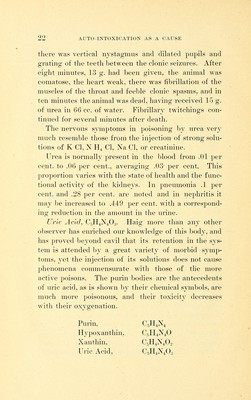
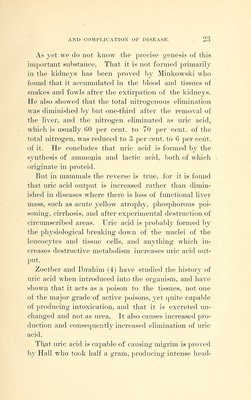
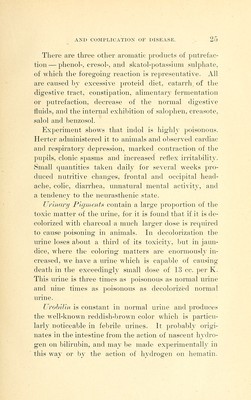
![The pendulum of opinion as to the toxicity of urea and the part it plays in the causation of uremia, has swung from one extreme, in which it was thought that it did not particijDate in any material way in its ])yo- duction, to the other, in which it was considered as the sole cause of uremia. Bouchard has claimed that it has but little toxic action, but the more exhaustive re- searches of Herter (3) have shown that it is a very important toxic factor, symptoms of uremia invariably following whenever the ^^ercentage of urea in the blood of animals exceeds .4 per cent, or .5 per cent., death resulting when it reaches .6 per cent, or 1 per cent, of the body weight. When injected into dogs in aqueous solution, fibril- lary twitchings, clonic convulsions, intractable diarrhea and intense congestion of the intestinal mucous mem- brane were observed. The diuresis occasioned was enormous, the kidneys doing in an hour that which they would usually perform in a day. The excretion of urea was markedly increased, not from the elimina- tion of the urea given, but from increased nitrogenous metabolism of the tissues. When the dosao-e was o large, or the urea was rapidly administered, there was hemoglobinuria and hematuria, but these disappeared upon the advent of free diuresis; there was very little influence upon blood pressure. In a ring-tailed monkey of about 2 K. weight, 5 grams joroduced fibrillary twitchings and internal stra- bismus in four and one-half minutes. The injection was continued and in four and one-half minutes 7.5 g. had been given, producing violent general clonic spasms. After seven and one-half minutes 11 g. had been given, the respirations were labored and deep,](https://iiif.wellcomecollection.org/image/b21175688_0025.jp2/full/800%2C/0/default.jpg)