A popular history of British seaweeds : comprising their structure, fructification, specific characters, arrangement, and general distribution, with notices of some of the fresh-water algae / by D. Landsborough.
- David Landsborough
- Date:
- 1857
Licence: Public Domain Mark
Credit: A popular history of British seaweeds : comprising their structure, fructification, specific characters, arrangement, and general distribution, with notices of some of the fresh-water algae / by D. Landsborough. Source: Wellcome Collection.
371/464 page 313
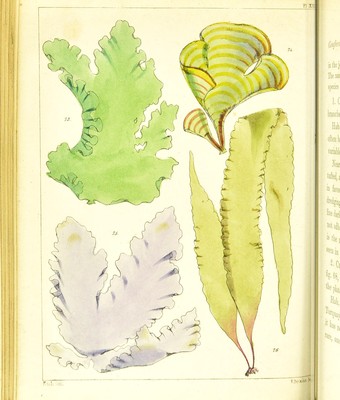
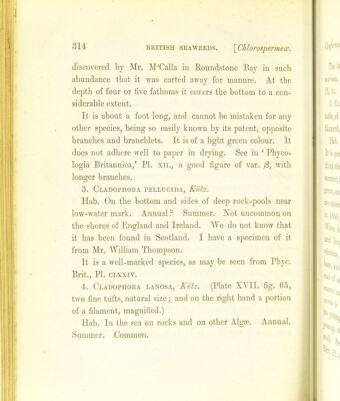
![in the joints, having at some period a proper ciliary motion.— The name means branch-bearing, Conferva being retained for the species with simple filaments. 1. Cladopiiora rupkstris, Kiilz. (Plate XVII. fig. 67, branches, of natural size, and a branehlet, magnified.) Hab. On rocks in the sea, from high-water mark, and often beyond that. Annual. Summer. Very common and variable. Xear high-water mark it is a plain-looking plant, closely tufted, and of a dirty greyish-green colour. When obtained in favourable circumstances, in deep rock-pools, or by dredging from deep water, it is truly a lovely plant, of a fine dark green. The only draw-back to it is that it does not adhere well to paper in drying; and this, we doubt not, is the reason why this beautiful species is less frequently seen in collections than we might expect. 2. Cladophora rectangularis, Griffiths. (Plate XVII. fig. 68, plant, natural size; to the right, at the bottom of the plate, there is a portion of a branch magnified.) Hab. In the sea, in dee]) water. Annual. Summer. Torquay, Mr. Borrcr, Mrs. Griffiths; Galway, Mr. lleilly; it has not been found in Scotland ; in England it is very rare, and it was thought to be so in Ireland, till it was](https://iiif.wellcomecollection.org/image/b28083933_0371.jp2/full/800%2C/0/default.jpg)

 No text description is available for this image
 No text description is available for this image
 No text description is available for this image