The microscopist : a manual of microscopy and compendium of the microscopic science : micro-minerology, micro-chemistry, biology, histology, and pathological histology / by J.H. Wythe.
- Joseph Henry Wythe
- Date:
- 1877
Licence: Public Domain Mark
Credit: The microscopist : a manual of microscopy and compendium of the microscopic science : micro-minerology, micro-chemistry, biology, histology, and pathological histology / by J.H. Wythe. Source: Wellcome Collection.
Provider: This material has been provided by the Francis A. Countway Library of Medicine, through the Medical Heritage Library. The original may be consulted at the Francis A. Countway Library of Medicine, Harvard Medical School.
28/362 page 26
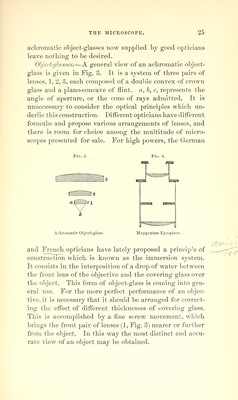
![Eye-])U'ces.—The eye-piece usually employed is the Hny- genian, or negative eye-piece (Fig. 4). This is composed of two plano-convex lenses, with their plane sides next the eye. Their focal lengths are as 1 to 3, and their distance apart half the sum of their focal distances. Several of these, having different magnifying powers, are supplied wdth good microscopes. It is best to use a weak eye-piece, increasing the power of the instrument by stronger objectives when necessary. Ivellner's eye-piece has the lens next the eye made achromatic. The peri- scopic ej^e-piece of some of the German opticians has both lenses double convex. This gives a larger field of view with some loss of accurate definition. For high powers, I have used a strong meniscus in place of the lower lens in the Huygenian eye-piece. Dr. Royston Pigott has suggested improvements in eye-pieces by using an inter- mediate Huygenian combination, reversed, between the objective and ordinary eye-piece. This gains power, but somewhat sacrifices definition. 8till better, he has pro- posed an aplanatic combination, consisting of a pair of slightly overcorrected achromatic lenses, mounted mid- way between a low eye-piece and the objective. This has a separating adjustment so as to traverse two or three inches. The focal length of the combination varies from one and a half to three-fourths of an inch. The future improvement of the microscope must be looked for in this direction, since opticians seem to have approached the limit of perfection in high power objectives, some of which have been made equivalent to g'othi or y^o^^ of an inch focal length. As an amplifier, I have used a double concave lens of an inch in diameter and a virtual focus of one and a half inches between the object-glass and the eye-piece. If the object-glass be a good one, this will permit the use of a very strong eye-piece with little loss of defining power, and greatly increase the apparent size of the object.](https://iiif.wellcomecollection.org/image/b21085225_0028.jp2/full/800%2C/0/default.jpg)