The principles and practice of bandaging : by Gwilym G. Davis.
- Gwilym George Davis
- Date:
- 1891
Licence: Public Domain Mark
Credit: The principles and practice of bandaging : by Gwilym G. Davis. Source: Wellcome Collection.
Provider: This material has been provided by the Francis A. Countway Library of Medicine, through the Medical Heritage Library. The original may be consulted at the Francis A. Countway Library of Medicine, Harvard Medical School.
106/130 (page 48)
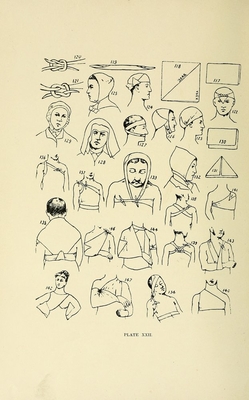
![PART III THE HANDKERCHIEF BANDAGES. Handkerchief bandages are those made of handkerchiefs or other material in the form of a square. They have been in use for centuries, but in 1832, Mayor, a surgeon of Lausanne, Switzerland, published a work entitled, JJn nouveau systeme de deligation chirurgicale. In this work he added many new bandages to those already existing, classified and named them, and advocated their use for all parts of the body. He enlarged and systematized thfr subject so well, that he has been regarded as the originator of a new system of surgical dressings, and it is spoken of as Mayor's' System of Handkerchief Dressings. In many cases these dressings are far superior to the roller bandages, particularly where support rather than pressure is desired,, as in the handkerchiefs for the arm. Sometimes they can be well applied to places that it is very difficult to cover satisfactorily with, a roller bandage, as the gluteal region. When an application has been made to a part that requires fre-^ quent attention, the handkerchief bandage allows ready access to it; thus in contusions of the shoulder in which it is desired to apply^ an evaporating lotion, the triangular cap retains the dressing well, and at the same time by freeing and turning down the point of the triangle, the dressing can at once be inspected. They are also useful as provisional dressings in war and cases of accident. The roller bandage is sometimes impossible to obtain, while the handkerchief is found everywhere, and a person possess- ing some knowledge of the subject, can with the exercise of a little ingenuity, adapt them to almost any form of injury. Materials.—Handkerchief bandages are made with cotton, linen or silk squares, of various sizes, according to the parts to be covered.. The material used should be thin and pliable. If unbleached [48]](https://iiif.wellcomecollection.org/image/b21048599_0106.jp2/full/800%2C/0/default.jpg)