The principles and practice of bandaging : by Gwilym G. Davis.
- Gwilym George Davis
- Date:
- 1891
Licence: Public Domain Mark
Credit: The principles and practice of bandaging : by Gwilym G. Davis. Source: Wellcome Collection.
Provider: This material has been provided by the Francis A. Countway Library of Medicine, through the Medical Heritage Library. The original may be consulted at the Francis A. Countway Library of Medicine, Harvard Medical School.
97/130 (page 41)
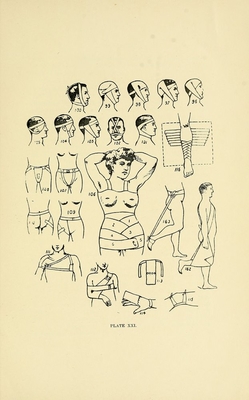
![THE TAILED BANDAGES. The tailed bandages are so called because they consist of a strip or strips of material so fastened together or divided as to possess three or more extremities or tails. When these strips are fastened at right angles to one another in the shape of the letter T, they are called T bandages. When there is only one transverse and one upright part, it is called a single T bandage, but when there are two upright pieces, it is called a double T bandage. When a single broad piece of bandage is torn from the ends nearly to the center, it sometimes receives the name of sling. The ends are called tails and the part in the center remaining untorn is called the body. In applying them, the body is first placed over the affected part and then the tails carried around the opposite side and fastened. The tailed bandages can be multiplied indefinitely, and, with the exercise of a little ingenuity, can be applied to all parts of the body, Sufticient examples are given to show the manner of their construction and the principles of application. In many cases they are to be preferred to the roller bandage, particularly when the patient is confined to bed or the dressings require frequent changes., They are not, however, suitable for making pressure. TAILED BANDAGES OF THE HEAD. The Four Tailed Bandage of the Head. (Figs. 96, 97 and 98.)—A piece of material eight inches wide and long enough to go over the scalp and tie under the chin, is torn from either extremity to within three or four inches of the middle. The body of the bandage being placed on the top of the head, the two posterior tails are tied nnder the chin and the two anterior ones around the back [41]](https://iiif.wellcomecollection.org/image/b21048599_0097.jp2/full/800%2C/0/default.jpg)