A treatise on the venereal disease / by John Hunter ; with notes by George G. Babington.
- John Hunter
- Date:
- 1841
Licence: Public Domain Mark
Credit: A treatise on the venereal disease / by John Hunter ; with notes by George G. Babington. Source: Wellcome Collection.
Provider: This material has been provided by the National Library of Medicine (U.S.), through the Medical Heritage Library. The original may be consulted at the National Library of Medicine (U.S.)
149/348
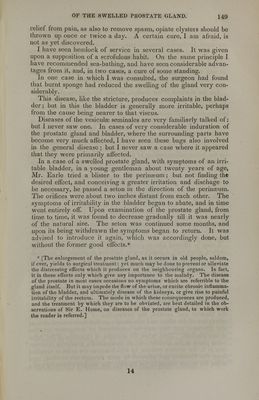
![relief from pain, as also to remove spasm, opiate clysters should be thrown up once or twice a day. A certain cure, I am afraid, is not as yet discovered. I have seen hemlock of service in several cases. It was given upon a supposition of a scrofulous habit. On the same principle I have recommended sea-bathing, and have seen considerable advan- tages from it, and, in two cases, a cure of some standing. In one case in which I was consulted, the surgeon had found that burnt sponge had reduced the swelling of the gland very con- siderably. This disease, like the stricture, produces complaints in the blad- der ; but in this the bladder is generally more irritable, perhaps from the cause being nearer to that viscus. Diseases of the vesicular seminales are very familiarly talked of; but I never saw one. In cases of very considerable induration of the prostate gland and bladder, where the surrounding parts have become very much affected, I have seen these bags also involved in the general disease ; but I never saw a case where it appeared that they were primarily affected. In a case of a swelled pi'ostate gland, with symptoms of an irri- table bladder, in a young gentleman about twenty years of age, Mr. Earle tried a blister to the perinasum; but not finding the desired effect, and conceiving a greater irritation and dischage to be necessary, he passed a seton in the direction of the perinosum. The orifices were about two inches distant from each other. The symptoms of irritability in the bladder began to abate, and in time went entirely off. Upon examination of the prostate gland, from time to time, it was found to decrease gradually till it was nearly of the natural size. The seton was continued some months, and upon its being withdrawn the symptoms began to return. It was advised to introduce it again, which was accordingly done, but without the former good effects.* * [The enlargement of the prostate gland, as it occurs in old people, seldom, if ever, yields to surgical treatment: yet much may be done to prevent or alleviate the distressing effects which it produces on the neighbouring organs. In fact, it is these effects only which give any importance to the malady. The disease of the prostate in most cases occasions no symptoms which are referrible to the gland itself. But it may impede the flow of the urine, or excite chronic inflamma- tion of the bladder, and ultimately disease of the kidneys, or give rise to painful irritability of the rectum. The mode in which these consequences are produced, and the treatment by which they are to be obviated, are best detailed in the ob- servations of Sir E. Home, on diseases of the prostate gland, to which work the reader is referred.] 14](https://iiif.wellcomecollection.org/image/b21131508_0149.jp2/full/800%2C/0/default.jpg)