A treatise on the venereal disease / by John Hunter ; with notes by George G. Babington.
- John Hunter
- Date:
- 1841
Licence: Public Domain Mark
Credit: A treatise on the venereal disease / by John Hunter ; with notes by George G. Babington. Source: Wellcome Collection.
Provider: This material has been provided by the National Library of Medicine (U.S.), through the Medical Heritage Library. The original may be consulted at the National Library of Medicine (U.S.)
162/348
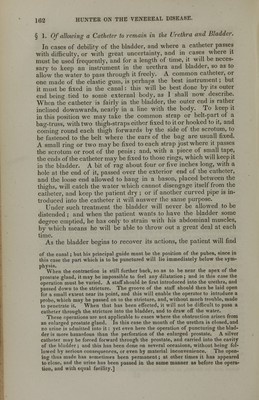
![§ 1. Of allowing a Catheter to remain in the Urethra and Bladder. In cases of debility of the bladder, and where a catheter passes with difficulty, or with great uncertainty, and in cases where it must be used frequently, and for a length of time, it will be neces- sary to keep an instrument in the urethra and bladder, so as to allow the water to pass through it freely. A common catheter, or one made of the elastic gum^is perhaps the best instrument; but it must be fixed in the canal: this will be best done by its outer end being tied to some external body, as I shall now describe. When the catheter is fairly in the bladder, the outer end is rather inclined downwards, nearly in a line with the body. To keep it in this position we may take the common strap or belt-part of a bag-truss, with two thigh-straps either fixed to it or hooked to it, and coming round each thigh forwards by the side of the scrotum, to be fastened to the belt where the ears of the bag are usuall fixed. A small ring or two maybe fixed to each strap just where it passes the scrotum or root of the penis; and, with a piece of small tape, the ends of the catheter may be fixed to those rings, which will keep it in the bladder. A bit of rag about four or five inches long, with a hole at the end of it, passed over the exterior end of the catheter, and the loose end allowed to hang in a bason, placed between the thighs, will catch the water which cannot disengage itself from the catheter, and keep the patient dry ; or if another curved pipe is in- troduced into the catheter it will answer the same purpose. Under such treatment the bladder will never be allowed to be distended; and when the patient wants to have the bladder some degree emptied, he has only to strain with his abdominal muscles, by which means he will be able to throw out a great deal at each time. As the bladder begins to recover its actions, the patient will find of the canal ; but his principal guide must be the position of the pubes, since in this case the part which is to be punctured will lie immediately below the sym- physis. When the contraction is still further back, so as to be near the apex of the prostate gland, it may be impossible to feel any dilatation ; and in this case the operation must be varied. A staff should be first introduced into the urethra, and passed down to the stricture. The groove of the staff should then be laid open for a small extent near its point, and this will enable the operator to introduce a probe, which may be passed on to the stricture, and, without much trouble, made to penetrate it. When that has been effected, it will not be difficult to pass a catheter through the stricture into the bladder, and to draw off the water. These operations are not applicable to cases where the obstruction arises from an enlarged prostate gland. In this case the mouth of the urethra is closed, and no urine is admitted into it: yet even here the operation of puncturing the blad- der is more hazardous than the perforation of the enlarged prostate. A silver catheter may be forced forward through the prostate, and carried into the cavity of the bladder; and this has been done on several occasions, without being fol- lowed by serious consequences, or even by material inconvenience. The open- ing ihus made has sometimes been permanent; at other times it has appeared to close, and the urine has been passed in the same manner as before the opera- tion, and with equal facility.]](https://iiif.wellcomecollection.org/image/b21131508_0162.jp2/full/800%2C/0/default.jpg)