A treatise on the venereal disease / by John Hunter ; with notes by George G. Babington.
- John Hunter
- Date:
- 1841
Licence: Public Domain Mark
Credit: A treatise on the venereal disease / by John Hunter ; with notes by George G. Babington. Source: Wellcome Collection.
Provider: This material has been provided by the National Library of Medicine (U.S.), through the Medical Heritage Library. The original may be consulted at the National Library of Medicine (U.S.)
23/348
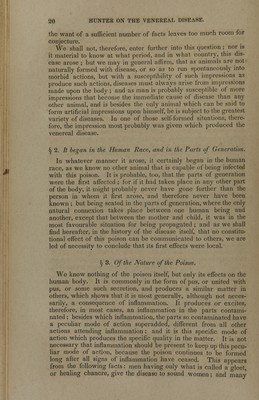
![§ 4. Of the greater or less Acrimony of the Poison. Yenereal matter must in all cases be the same : one quantity of matter cannot have a greater degree of poisonous quality than another : and if there is any difference it is only in its being more or less diluted, which produces no difference in its effects. One can conceive, however, that it may be so far diluted as not to have the power of irritation. Thus any fluid taken into the mouth, capable of stimulating the nerves to taste, may be so diluted, as not to be tasted. But if the poison can irritate the part to which it is applied to action, it is all that is required: the action will be the same, whether from a large or small quantity, from a strong or a weak solution.* We find from experience that there is no difference in the kind of matter ; and no variation can arise in the disease from the matter's being of different degrees of strength, for it appears that the same matter affects very differently different people. Two men having been connected with one woman, and both catching the disease, one of them shall have a violent gonorrhoea, or chancre, while the other shall have merely a slight gonorrhoea. I have known one man give the disease to different women, and some of the women have had it very severely, while in others it has been very slight. The same reasoning holds good with regard to chancres. The variations of the symptoms in different persons depend upon the constitution and habit of the patient at the time. What happens in the inoculation of the small-pox strengthens this opinion. Let the symptoms of the patient from whom the matter is taken be good or bad ; let it be from one who has had a great many pustules, or from one who has had but few; let it be from the confluent or distinct kind, applied in a large quantity or a small one, it produces always the same effect. This could only be known by the great numbers that have been inoculated under all these different circumstances.f § 5. Of the Poison being the same in Gonorrhoea and in Chancre. It has been supposed by many that the gonorrhoea and the chancre arise from two distinct poisons ; and their opinion seems to have some foundation, when we consider only the different appearances * These words added, Since those men who have taken great pains in wash- ing the parts immediately after connexion have caught the disease, and the symp- toms have been equally severe as in others who used no such precaution.— Home, f [Sir E. Home has here added a note, in which he calls in question the truth of this doctrine, as far as regards sma!l-pox. He says that he has in many in- stances diluted the variolous matter, and always found that the disease produced from such matter was milder than when employed for inoculation in an undiluted state. However, in the venereal disease it must be acknowledged that there are no facts which prove the existence of a similar difference in the virulence of the contagion, or would justify the conclusion that the variations in the symptoms depend on any other cause than the constitution and habit of the recipient.]](https://iiif.wellcomecollection.org/image/b21131508_0023.jp2/full/800%2C/0/default.jpg)