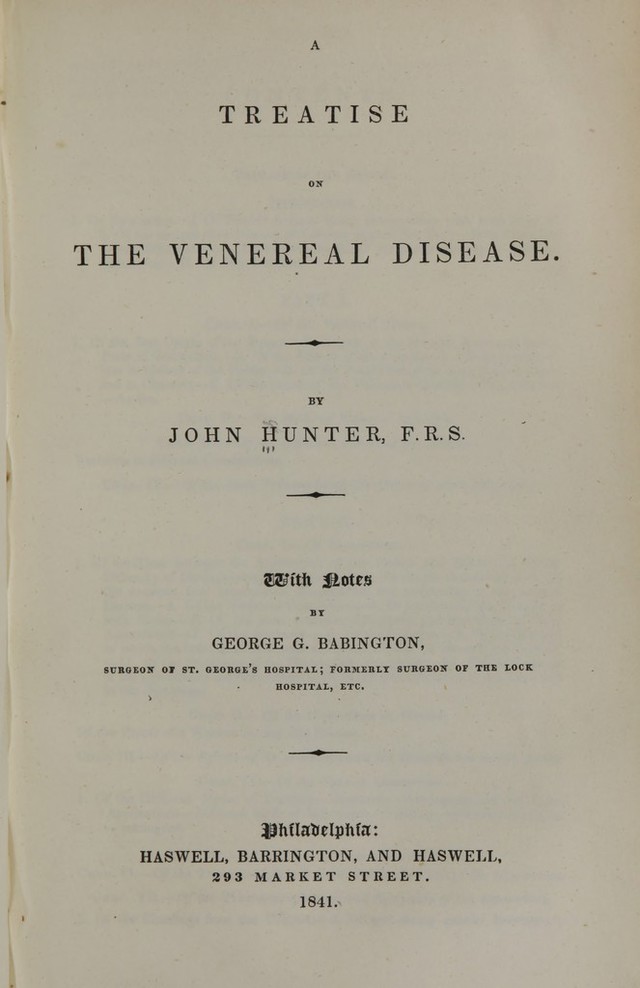
A treatise on the venereal disease / by John Hunter ; with notes by George G. Babington.
- John Hunter
- Date:
- 1841
Licence: Public Domain Mark
Credit: A treatise on the venereal disease / by John Hunter ; with notes by George G. Babington. Source: Wellcome Collection.
Provider: This material has been provided by the National Library of Medicine (U.S.), through the Medical Heritage Library. The original may be consulted at the National Library of Medicine (U.S.)
86/348
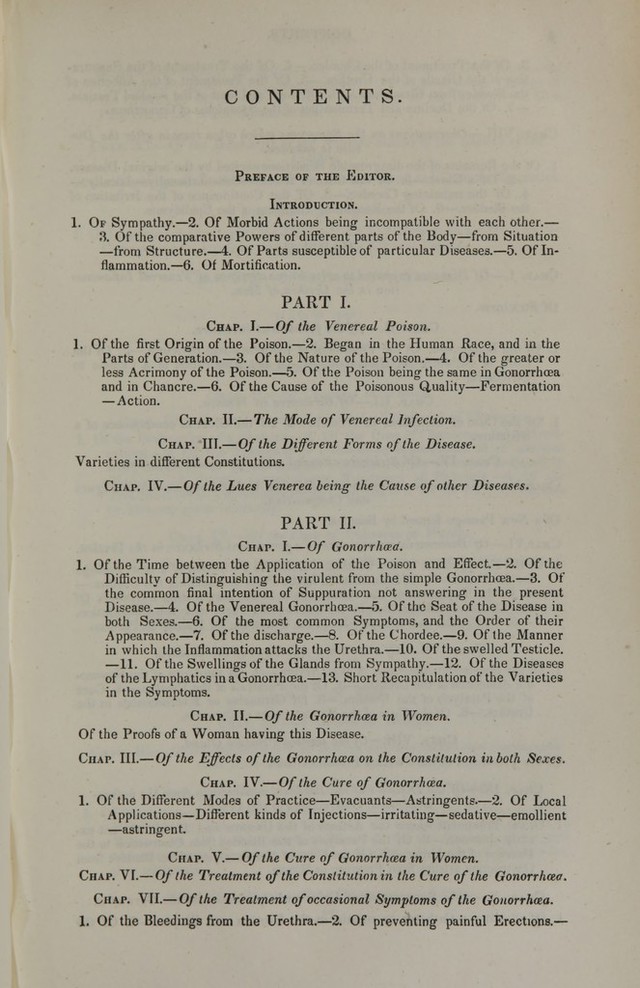
![§ 6. Of the Treatment of the Swelled Testicle. When the testicle sympathises either with the urethra or bladder, and is inflamed, rest is the best remedy. The horizontal position of the body is the easiest, as such a position is the best for a free circulation. If the patient cannot submit to a horizontal position, it is absolutely necessnry to have the testicle well suspended. Indeed the patient will be happy in having recourse to that expe- dient as soon as he is acquainted with the ease which it affords. In this complaint, perhaps, no particular method of cure can be laid down. It is to be treated as inflammation in general, by bleed- ing and purging, if the constitution requires them, and by fomenta- tion and poultices. Bleeding with leeches has often been of service. This we cannot well account for, as the vessels of the scrotum have but little connexion with those of the testicle. As I do not look upon the swelling of the testicle to be venereal, mercurials, in my opinion, can be of no service in these cases while the inflammation continues; but they are useful when that is gone and the induration only remains.* Vomits have been recommended in such cases, and are some- times of service. I have known a vomit to remove the swelling almost instantaneously. The effects of the vomit most probably arise from the sympathy between the stomach and the testicle. Opiates are of service, as they are in most irritations of those parts. When such swellings suppurate, which they seldom do, they require only to be treated as common suppurations, and mercury need not be given. In the history of this disease I observed, and indeed it has been observed by most writers, that when a swelling comes upon the testicle in consequence of a gonorrhoea the running ceases, or when the running ceases the testicle swells; but which is the cause, or which is the effect, has not yet been ascertained. It has been also observed that when the running returns, the testicle then shows the first symptoms of recovery; so that the testicle having lost its sym- pathizing action, the action is restored to the urethra. And here also it has not yet been ascertained which is the cause or which is the effect; but, from a supposition that the cessation of the discharge in the urethra is the cause of the swelling, it has been attributed to the mode of treatment of that irritation, and by some to injections. It has been advised by many, and attempted by some, to procure a return of the running; but the methods used have hardly been founded upon any sound principle. Mr. Bromfield appears to have been the first who recommended a treatment suitable to this theory, * [Though mercurials are not required for the sake of counteracting the vene- real virus, yet experience shows that calomel is of the greatest service, even in the acute stage of inflammation of the testicle. It is probable that it acts here, as in many other cases of adhesive inflammation, by controlling the capillarv circulation of the inflamed part. It should always be combined with puraatives, and generally with local bleeding.] v 5 '](https://iiif.wellcomecollection.org/image/b21131508_0086.jp2/full/800%2C/0/default.jpg)