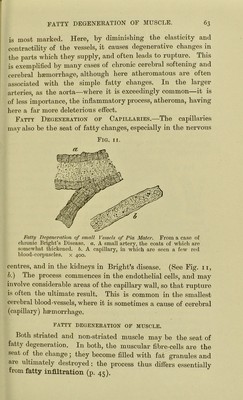
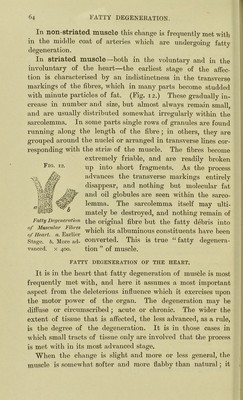
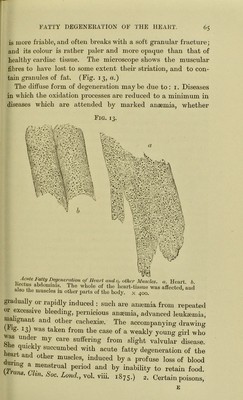
Licence: Public Domain Mark
Credit: An introduction to pathology and morbid anatomy / by T. Henry Green. Source: Wellcome Collection.
Provider: This material has been provided by the Royal College of Physicians of Edinburgh. The original may be consulted at the Royal College of Physicians of Edinburgh.
99/648 (page 71)
![fever, which, they say, causes increased destruction of albumen. This, however, seems like arguing in a circle, for it is increased destruction of tissue which produces the elevation of tempera- ture : moreover, the change is not most marked in long- continued secondary fevers, but in the relatively short primary fevers of the acute specific diseases. Further, the degeneration is specially pronounced in bad cases of diphtheria, in which disease the temperature is often low. All this leads to the belief that the infective material in the blood—the cause of the fever—has a more or less deleterious action on the tissues. This is supported by the observation that cloudy swelling is the first change noticeable in poisoning by phos- phorus, arsenic, and the mineral acids, all of which lead ultimately to fatty degeneration of protoplasm. Lastly, cloudy swelling is found in inflamed parts, and we shall see, when considering inflammation, that it is always due to the action of an irritant, which, if it were of sufficient intensity, would produce death of the tissue. It would appear, therefore, that cloudy swelling is due to the action upon the tissues of some noxa which tends to cause their death ; elevation of the temperature of protoplasm above the normal undoubtedly acts in this way. In considering the histology of this change, we shall find that advanced cloudy swelling passes insensibly into fatty metamorphosis : it is, therefore, to be regarded as the first step towards fatty metamorphosis. SEATS.—The large masses of protoplasm, naturally, show the change most plainly—the liver, kidneys and muscles; but probably all protoplasm suffers. The change may be much more advanced in some organs than in others, owing perhaps to differences in the local circulation. NAKED-EYE APPEARANCES.—When the change is well-marked, the organs (liver or kidney) are slightly swollen, and may be either anaemic or slightly hyperaunic; the surface * S^tlon bu]Ses UP somewhat, the tissue is more or less markedly opaque, and is softer than natural.](https://iiif.wellcomecollection.org/image/b21915854_0099.jp2/full/800%2C/0/default.jpg)