The mission of the National Science Foundation : hearing before the Subcommittee on Science of the Committee on Science, Space, and Technology, U.S. House of Representatives, One Hundred Third Congress, first session, March 3, 1993.
- United States. Congress. House. Committee on Science, Space, and Technology. Subcommittee on Science
- Date:
- 1993
Licence: Public Domain Mark
Credit: The mission of the National Science Foundation : hearing before the Subcommittee on Science of the Committee on Science, Space, and Technology, U.S. House of Representatives, One Hundred Third Congress, first session, March 3, 1993. Source: Wellcome Collection.
5/320 page 1
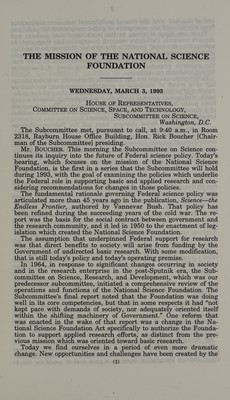
![THE MISSION OF THE NATIONAL SCIENCE FOUNDATION WEDNESDAY, MARCH 3, 1993 HOUSE OF REPRESENTATIVES, COMMITTEE ON SCIENCE, SPACE, AND TECHNOLOGY, SUBCOMMITTEE ON SCIENCE, Washington, D.C. The Subcommittee met, pursuant to call, at 9:40 a.m., in Room 2318, Rayburn House Office Building, Hon. Rick Boucher [Chair- man of the Subcommittee] presiding. Mr. BOUCHER. This morning the Subcommittee on Science con- tinues its inquiry into the future of Federal science policy. Today’s hearing, which focuses on the mission of the National Science Foundation, is the first in a series that the Subcommittee will hold during 1993, with the goal of examining the policies which underlie the Federal role in supporting basic and applied research and con- sidering recommendations for changes in those policies. The fundamental rationale governing Federal science policy was articulated more than 45 years ago in the publication, Science—the Endless Frontier, authored by Vannevar Bush. That policy has been refined during the succeeding years of the cold war. The re- port was the basis for the social contract between government and the research community, and it led in 1950 to the enactment of leg- islation which created the National Science Foundation. The assumption that underpinned Federal support for research was that direct benefits to society will arise from funding by the Government of undirected basic research. With some modification, that is still today’s policy and today’s operating premise. In 1964, in response to significant changes occurring in society and in the research enterprise in the post-Sputnik era, the Sub- committee on Science, Research, and Development, which was our predecessor subcommittee, initiated a comprehensive review of the operations and functions of the National Science Foundation. The Subcommittee’s final report noted that the Foundation was doing | well in its core competencies, but that in some respects it had “not kept pace with demands of society, nor adequately oriented itself within the shifting machinery of Government.” One reform that was enacted in the wake of that report was a change in the Na- tional Science Foundation Act specifically to authorize the Founda- tion to support applied research efforts, as distinct from the pre- vious mission which was oriented toward basic research. Today we find ourselves: in a period of even more dramatic change. New opportunities and challenges have been created by the](https://iiif.wellcomecollection.org/image/b32218266_0005.jp2/full/800%2C/0/default.jpg)