Volume 1
Recent advances in organic chemistry / by Alfred W. Stewart.
- Alfred Walter Stewart
- Date:
- 1927
Licence: Attribution-NonCommercial 4.0 International (CC BY-NC 4.0)
Credit: Recent advances in organic chemistry / by Alfred W. Stewart. Source: Wellcome Collection.
54/412 page 34
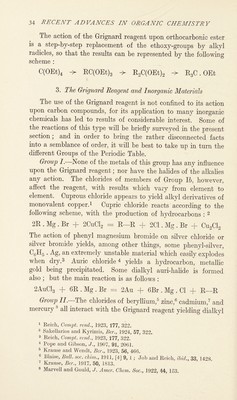
![The action of the Grignard reagent upon orthocarbonic ester is a step-by-step replacement of the ethoxy-groups by alkyl radicles, so that the results can be represented by the following scheme : C(OEt)4 -> RC(OEt)3 -> R2C(OEt)2 -> R3C. OEt 3. The Grignard Reagent and Inorganic Materials The use of the Grignard reagent is not confined to its action upon carbon compounds, for its application to many inorganic chemicals has led to results of considerable interest. Some of the reactions of this type will be briefly surveyed in the present section; and in order to bring the rather disconnected facts into a semblance of order, it will be best to take up in turn the different Groups of the Periodic Table. Group I.—None of the metals of this group has any influence upon the Grignard reagent; nor have the halides of the alkalies any action. The chlorides of members of Group Ib, however, affect the reagent, with results which vary from element to element. Cuprous chloride appears to yield alkyl derivatives of monovalent copper.1 Cupric chloride reacts according to the following scheme, with the production of hydrocarbons : 2 2P . Mg . Br + 2CuC12 = R—R + 2C1. Mg . Br + Cu2Cl2 The action of phenyl magnesium bromide on silver chloride or silver bromide yields, among other things, some phenyl-silver, C6H5 . Ag, an extremely unstable material which easily explodes when dry.3 Auric chloride4 yields a hydrocarbon, metallic gold being precipitated. Some dialkyl auri-halide is formed also ; but the main reaction is as follows : 2AuC13 -f- 6R . Mg . Br = 2Au -j- 6Br . Mg . Cl -j- R—R Group 11— The chlorides of beryllium,5 zinc,6 cadmium,7 8 and mercury s all interact with the Grignard reagent yielding dialkyl 1 Reich, Compt. rend., 1923, 177, 322. 2 Sakellarios and Kyrimis, Ber., 1924, 57, 322. 3 Reich, Compt. rend., 1923, 177, 322. 4 Pope and Gibson, J., 1907, 91, 2061. 5 Krause and Wendt, Ber., 1923, 56, 466. c Blaise, Bull. soc. chim., 1911, [4] 9, 1 ; Job and Reich, ibid., 33, 1428. 7 Krause, Ber., 1917, 50, 1813. 8 Marvell and Gould, J. Amer. Chem. Soc., 1922, 44, 153.](https://iiif.wellcomecollection.org/image/b29928114_0001_0054.jp2/full/800%2C/0/default.jpg)


 No text description is available for this image
 No text description is available for this image
 No text description is available for this image