The child : a study in the evolution of man / by Alexander F. Chamberlain.
- Alexander Francis Chamberlain
- Date:
- 1906
Licence: In copyright
Credit: The child : a study in the evolution of man / by Alexander F. Chamberlain. Source: Wellcome Collection.
92/544 page 74
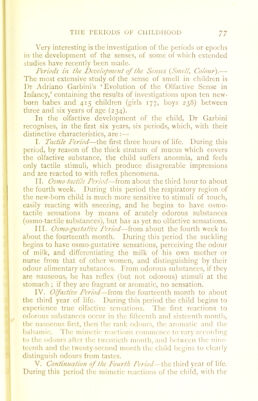
![ing to Dr W. S. Christopher, of Chicago, there are, from the medical point of view, three critical periods in child-life: i. Infancy^ practically the first three years of life, ‘with the gastro-enteric tract as the place of least resistance.’ The use of the bottle seems one of the chief factors in the production of great infant mortalit)’, and ‘ nursing is as much a part of the reproductive process as the development of the child in uteroJ Exaggerated pathogenic influence has been ascribed to the process of cutting the teeth, ‘ which is practically without harm to the child, and the relationship between the dangers to child-life and the period of dentition is purely one of coin- cidence.’ Food-poisons are the great danger here. 2. TJie fatigue period—from seven to nine years—a period during which ‘ fatigue occurs very readily, and one in which damage to the heart is likely to be produced.’ Dilated heart, shortness of breath, and ‘ an appearance of general laziness ’ (which, above all things else, does not call for more exercise, but less labour and fatigue, less school-work and less forced expenditure of energy) are common at this time—the statistics of some 32,800 school-children (aged 6-13 years) seem to show that ‘ the child of seven fatigues less readily than the child of six, but the child of eight fatigues more readily than the child of either six or seven. The child of nine fatigues less readily than the child of eight, but has a fatigue limit about equal to that of a child of seven. As the years advance the readiness of fatigue diminishes materially ’ [the tests were concerned with voluntary motor ability and muscle-strength] ‘ until the period of puberty is reached, when again fatigue more readily occurs than in the years immediately preceding.’ 3. The period of puberty—in the girl between twelve and a half and fifteen and a half years ; in the boy somewhat later—a period characterised by danger to the reproductive organs, which are acquiring their potential strength, and to the brain, now subject to the great strain of school-life. During this period ‘the amount of food demanded is much larger than immediately before or imme- diately after’; lack of it and excessive study mean sterile women by-and-by. Periods f7'om the Point of View of Degeneracy.—Clouston, in his study of Ihe Neuroses of Development (114, p. 12), makes four divisions of the developmental period of human life, as follows: I. Formative and Fmbyronic Stage (Intra-Uterine life). 2. Period of most rapid Brain-Growth, Special Sense Education,](https://iiif.wellcomecollection.org/image/b28091309_0092.jp2/full/800%2C/0/default.jpg)



 No text description is available for this image
 No text description is available for this image
 No text description is available for this image