Treatise on gynæcology : medical and surgical / by S. Pozzi ; translated from the French edition under the supervision of, and with additions by Brooks H. Wells.
- Pozzi, S. (Samuel Jean), 1846-1918.
- Date:
- 1891-1892
Licence: Public Domain Mark
Credit: Treatise on gynæcology : medical and surgical / by S. Pozzi ; translated from the French edition under the supervision of, and with additions by Brooks H. Wells. Source: Wellcome Collection.
Provider: This material has been provided by the Augustus C. Long Health Sciences Library at Columbia University and Columbia University Libraries/Information Services, through the Medical Heritage Library. The original may be consulted at the the Augustus C. Long Health Sciences Library at Columbia University and Columbia University.
600/628 (page 558)
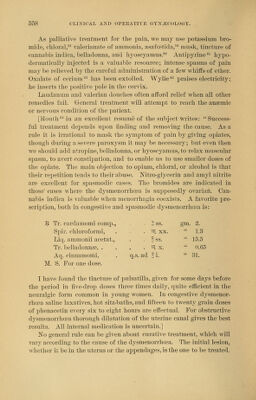
![As palliative treatment for the pain, we may use potassium bro- mide, chloral,58 valerianate of ammonia, asafcetida,59 musk, tincture of cannabis indica, belladonna, and hyoscyamus.60 Antipyrine61 hypo- dermatically injected is a valuable resource; intense spasms of pain may be relieved by the careful administration of a few whiffs of ether. Oxalate of cerium62 has been extolled. Wylie63 praises electricity; he inserts the iDositive pole in the cervix. Laudanum and valerian douches often afford relief when all other remedies fail. General treatment will attempt to reach the anaemic or nervous condition of the patient. [Routh64in an excellent resume of the subject writes: Success- ful treatment depends upon finding and removing the cause. As a rule it is irrational to mask the symptom of pain by giving opiates, though during a severe paroxysm it may be necessary; but even then we should add atropine, belladonna, or hyoscyamus, to relax muscular spasm, to avert constipation, and to enable us to use smaller doses of the opiate. The main objection to opium, chloral, or alcohol is that their repetition tends to their abuse. Nitro-glycerin and amyl nitrite are excellent for spasmodic cases. The bromides are indicated in those1 cases where the dysmenorrhoea is supposedly ovarian. Can- nabis indica is valuable when menorrhagia coexists. A favorite pre- scription, both in congestive and spasmodic dysmenorrhoea is: $ Tr. cardamomi comp., - 3 ss. gm. 2. Spir. chloroformi, Liq. ammonii acetat., Tr. belladonna?, . Aq. cinnamomi, . q.s. ad % M. S. For one dose. I have found the tincture of Pulsatilla, given for some days before the period in five-drop doses three times daily, quite efficient in the neuralgic form common in young women. In congestive dysmenor- rhoea saline laxatives, hot sitz-baths, and fifteen to twenty grain doses of phenacetin every six to eight hours are effectual. For obstructive dysmenorrhoea thorough dilatation of the uterine canal gives the best results. All internal medication is uncertain.] No general rule can be given about curative treatment, which will vary according to the cause of the dysmenorrhoea. The initial lesion, whether it be in the uterus or the appendages, is the one to be treated. m xx. 1.3 3SS. 15.5 m x. 0.65 !i. 31.](https://iiif.wellcomecollection.org/image/b21210391_0600.jp2/full/800%2C/0/default.jpg)