Volume 1
Fownes' manual of chemistry : theoretical and practical / [George Fownes].
- George Fownes
- Date:
- 1877
Licence: Public Domain Mark
Credit: Fownes' manual of chemistry : theoretical and practical / [George Fownes]. Source: Wellcome Collection.
528/586 (page 510)
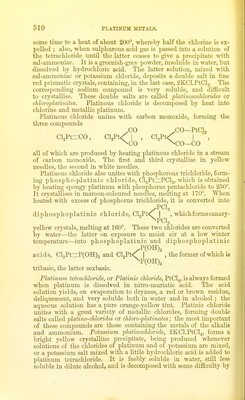
![some time to a lieat of about 200°, whereby balf tlie chlorine is ex- pelled ; also, when snlphurous acid gas is passed into a solution of the tetrachloride until the latter ceases to give a precipitate Mdth sal-ammoniac. It is a greenish-grey powder, insoluble in water, but dissolved by hydrochloric acid. The latter solution, mixed with sal-ammoniac or potassium chloride, deposits a double salt in fine red prismatic crystals, contaiuing, in the last case, 2KCLPtCl2. The corresponding sodium compound is very soluble, and difficult to crystallise. These double salts are called ^;Zah'iiosoc/iton(Zes or chloroplatinites. Platinous chloride is decomposed by heat into chloriae and metallic platinum. Platinous chloride unites with carbon monoxide, forming the three compounds .CO .CO—PtCl2 CLPt=CO, CLPt< I , CloPt< I ■ , \co \C0—CO all of which are produced by heating platinous chloride in a stream of carbon monoxide. The first and third crystallise in yellow needles, the second in white needles. Platinous chloride also unites with phosphorous trichloride, form- ing phospho-platinic chloride, Cl2PtnPCl3, which is obtained by heating spongy platinum with phosphorus pentachloride to 250°. It crystallises in maroon-coloured needles, melting at 170°. When heated with excess of phosphorus trichloride, it is converted into /PCI3 diphosphoplatinic chloride, ClaPt^ ] , which forms canary- PCI3 yellow crystals, melting at 160°. These two chlorides are converted by water-—the latter on exposure to moist air at a low winter temperature—into phosphoplatinic and diphosphoplatinic /P(0H)3 acids, CLPt=P(0H)3 and CLPt< | , the former of which is \P(0H)3 tribasic, the latter sexbasic. Platinum tetrachloride, or Platinic chloride, PtCl4, is always formed when platinum is dissolved in nitro-muriatic acid. The acid solution yields, on evaporation to dryness, a red or brown residue, deliquescent, and very soluble both in water and in alcohol; the aqueous solution has a pure orange-yellow tint. Platinic chloride unites with a great variety of metallic chlorides, forming double salts called ■platino-chlorides or chloro-platinates; the most important of these compounds are those containing the metals of the alkalis and ammonium. Potassium platinochloride, 2KCl.PtCl4, forms a bright yellow crystalline precipitate, being produced whenever solutions of the chlorides of platinum and of potassium are mixed, or a potassium salt mixed with a little hydrochloric acid is added to platinum tetrachloride. It is feebly soluble in water, still less soluble in dilute alcohol, and is decomposed -with some difficulty by](https://iiif.wellcomecollection.org/image/b21497710_0001_0528.jp2/full/800%2C/0/default.jpg)