Volume 1
Dictionarium scoto-celticum: a dictionary of the Gaelic language: comprising an ample vocabulary of Gaelic words ... with their signification and various meanings in English and Latin ... and vocabularies of Latin and English words, with their translation into Gaelic. To which are prefixed, an introduction explaining the nature, objects and sources of the work, and a compendium of Gaelic grammar / compiled by J. Macleod and others and published under the direction of the Highland Society of Scotland ; edited by M. Mackay.
- Date:
- 1828
Licence: Public Domain Mark
Credit: Dictionarium scoto-celticum: a dictionary of the Gaelic language: comprising an ample vocabulary of Gaelic words ... with their signification and various meanings in English and Latin ... and vocabularies of Latin and English words, with their translation into Gaelic. To which are prefixed, an introduction explaining the nature, objects and sources of the work, and a compendium of Gaelic grammar / compiled by J. Macleod and others and published under the direction of the Highland Society of Scotland ; edited by M. Mackay. Source: Wellcome Collection.
38/848 (page 14)
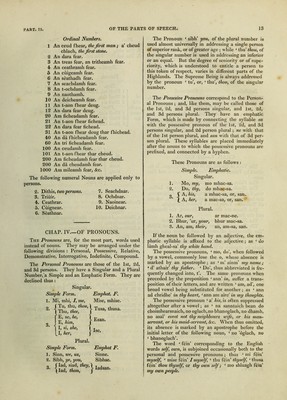
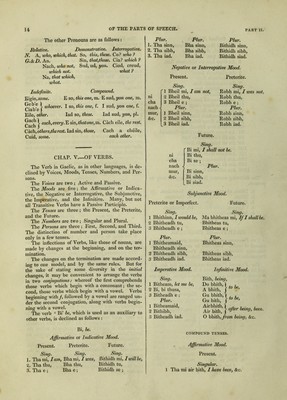
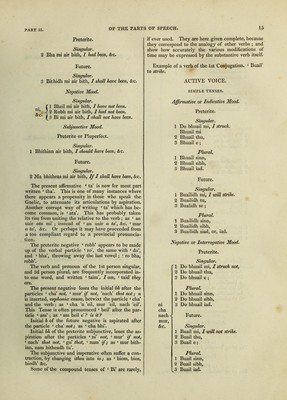
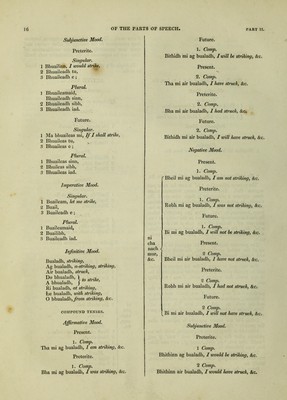
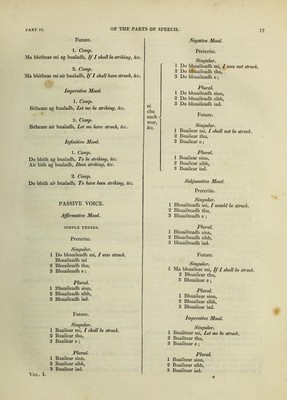
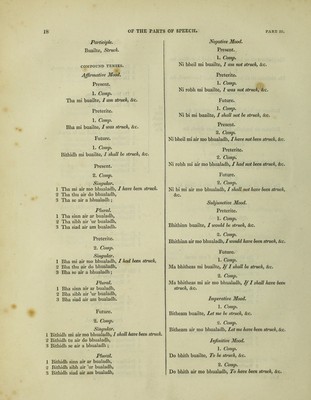
![The other Pronouns are as follows: Relative. Demonstrative. Interrogative. N. A, whx), which, that. So, this, these. Co? tcho ? G.&D. An. Sin, that,those. Cia? which ? Nach, who not. Sad, ud, yon. Ciod, creud, which not. what ? Na, that which, what. Indefinite. Compound. Eigin,some. E so, this one, m. E sud, yon one, m. uf i whoever. I so, this one, f. I sud, yon one, f. D 6 J Eile, other. lad so, these. lad sud, yon, pi. i each,every.'Ei ^m,thatone,m. Càch eile, the rest. Cdi(^,others,iherest.\dL^.%in,those, Cach a cheile, Cuid, some. each other. CHAP. V OF VERBS. The Verb in Gaelic, as in other languages, is de- clined by Voices, Moods, Tenses, Numbers, and Per- sons. The Voices are two ; Active and Passive. The Moods are five; the Affirmative or Indica- tive, the Negative or Interrogative, the Subjunctive, the Imperative, and the Infinitive. Many, but not all Transitive Verbs have a Passive Participle. The Tenses are three ; the Present, the Preterite, and the Future. Tlie Numbers are two; Singular and Plural. The Persons are three ; First, Second, and Third. The distinction of number and person take place only in a few tenses. The inflections of Verbs, like those of nouns, are made by changes at the beginning, and on the ter- mination. The changes on the termination are made accord- ing to one model, and by the same rules. But for the sake of stating some diversity in the initial changes, it may be convenient to arrange the verbs in two conjugations: whereof the first comprehends those verbs which begin with a consonant; the se- cond, those verbs which begin with a vowel. Verbs beginning with/, followed by a vowel are ranged un- der the second conjugation, along with verbs begin- ning with a vowel. The verb ‘ Bi’ be, which is used as an auxiliary to other verbs, is declined as follows ; Bi, be. Affirmative or Itidicative Mood. Present. Preterite. Future. Sing. Sing. Sing. 1. Tha mi, I am, Bha mi, / was, Bithidli mi, I will be, 2. Tha thu, Bha thu, Bithidh tu, 3. Tha e ; Bha e; Bithidh se ; Plur. Plur. Plur. 1. Tha sinn. Bha sinn. Bithidh sinn. 2. Tha sibh, Bha sibh. Bithidh sibh. 3. Tha iad. Bha iad. Bithidh siad. Negative or Interrogative Mood. Present. Preterite. '1 Sing. Bheil mi, I am not. Sing. Robh mi, I was not ni 2 Bheil thu. Robh thu. cha 3 Bheil e > Robh e; nach < Plur. Plur. mur. ] Bheil sinn. Robh sinn. &c. 2 Bheil sibh. Robh sibh. 3 Bheil iad. Robh iad. Future. Sing. ' Bi mi, I shall not be. ni Bi thu. cha Bi se ; nach < Plur mur. Bi sinn. dc. Bi sibh. ^ Bi siad. Subjunctive Mood. Preterite or Imperfect. Sing. 1 ^\\\Ùnnr\, Iwouldbe, 2 Bhitheadh tu, 3 Bhitheadh e : Future. Sing. Ma bhitheas mi. If I shall be. Bhitheas tu, Bhitheas e; Plur. 1 Bhitheamaid, Bhitheadh sinn, 2 Bhitheadh sibh, 3 Bhitheadh iad. Plur. Bhitheas sinn, Bhitheas sibh, Bhitheas iad. Imperative Mood. Infinitive Mood. Sing. 1 Bitheam, let me be, 2 Bi, bi thusa, 3 Bitheadh e; Plur. 1 Bitheamaid, 2 Bithibh, 3 Bitheadh iad. Bith, being. Do bhith, Ì . , Abhith, Gu bhith, 1 , , Gu hkh, Air bhith, I r, l ■ i Air bith, I O bhith,/rom being, &c. COMPOUND TENSES. Affirmative Mood. Present. Singular. 1 Tha mi air bith, I have beeii, &c.](https://iiif.wellcomecollection.org/image/b22012096_0001_0038.jp2/full/800%2C/0/default.jpg)