Volume 1
A system of human anatomy : including its medical and surgical relations / by Harrison Allen. With a section on histology. By E.O. Shakespeare.
- Harrison Allen
- Date:
- 1882-1884
Licence: Public Domain Mark
Credit: A system of human anatomy : including its medical and surgical relations / by Harrison Allen. With a section on histology. By E.O. Shakespeare. Source: Wellcome Collection.
Provider: This material has been provided by The University of Leeds Library. The original may be consulted at The University of Leeds Library.
16/110 page 24
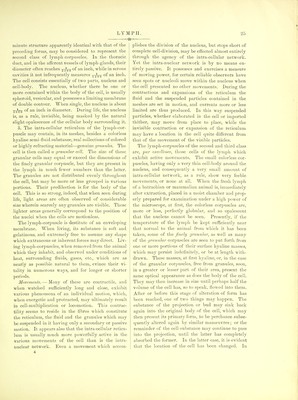
![XX>^<>Cx> many cells may even reach p^Vo inch. Their mean diameter is generally less m the efferent than in the afferent vessels of the lymph-glands. Number.—Their number in a given volume of the plasma has been found to vary quite as widely as their dimensions. Owing to several causes, particularly the viscosity (adhesiveness) of the corpuscles, the enumera- tion of these elements has always been accomplished with great difficulty, and consequently with much irre- gularity as to results. Notwithstanding this, however, the data obtained tend to establish, with considerable certainty, the following dicta: 1st. The number of lymph-corpuscles in any given volume of the plasma varies widely in different parts of the lymphatic system. 2d. In the efferent lymph-vessels of lymphatic glands and follicles they are much more numerous than in the afferent vessels of the same glands. 3d. They are usual- ly much less numerous in the smaller than in the larger lymph-vessels of the same course. Indeed, in many locations, the small radicles of the peripheral lymph- capillaries are almost entirely free of lymph-corpuscles. 4th. The small lymph-spaces and lymph-capillaries of the tendons and aponeuroses contain almost none in health, while in the loose connective tissues lymph- corpuscles are much more abundantly present. In the dog, lymph from the thoracic duct, at one observation, was found to contain 4800 globules per 0.08937 c. i.; at another time the number reached 7500 per 0.03937 c. i., while the number of white corpuscles in the blood was 25000 per 0.03937 c. i. In the rabbit, the same observer (Eanvier) found in the thoracic duct 11300 per 0.03937 c. f., whilst in the blood of the aorta only 7500 were enumerated. Minute constitution.—Both nucleus and cell-body consist of a fine network of colorless albumenoid ma- terial, which incloses in its meshes a semi-fluid sub- stance, usually also colorless. This network is visible only under very favorable conditions, generally after the action of certain reagents, yet it has been seen in other cells of the economy in sitH natura during the life of the animal. The nuclear portion of this network has been termed the intra-nuclear, while that of the surrounding cell-body has been named the intra-cellu- lar network; the fibres of the two intercommunicate through the limiting membrane of the nucleus. The opalescent or finely-granular appearance of this and of the preceding class of white cells or lymph-corpuscles is entirely due to the optical effect of the fine fibres forming the network. Seen in optical transverse sec- tion these minute fibres appear as fine grayish granules, and at the nodal or crossing pomts, resemble dots of similar aspect, the minute intermediate spaces seem- as. White blood-corpuscle, showing an intra^cellular and an intra-nuclcar reticulum, b. Elliptical colored blood- corpuscle, showing similar reticula. High power. (Klein.) ing more brilliant. It is this finely-mottled appearance which has suggested the use of the term '■'■finely granu- lar universally employed in describing some cells, for in many healthy living cells there are really no granules' to be found, a. Fig. 1, represents very fairly the net- works already referred to. The drawing also very well shows the difference in the closeness of the two reticula. By reference to the figure it will be readily observed that the meshes of the intra-cellular net- work are much wider than those of the intra-nuclear reticulum. It can now be readily understood that the semblance of a granule or pseudo-nucleus in the cell-body, or of a spot or pseudo-nucleolus within the nucleus, may be produced by means of a conden- sation or contraction of this reticulum at any point. Varieties.—For convenience of description lymph- corpuscles may be divided into three classes—the ex- treme forms of each class, however, gradually shading off into those of the others—as follows:— 1. In every specimen of lymph there are to be found small colorless corpuscles^ more or less spheroid in shape, composed of a single roundish nucleus, sur- rounded by an exceedingly small protoplasmic body. In their construction these small cells do not visibly differ from those of the next succeeding class, exce])t in the relative proportion of nucleus to cell-body. They are present in numbers varying according to the location from which the lymph may be obtained. In the thoracic duct their number is about equal to the elements of the second class, while in the efferent lymph-vessels of lymphatic follicles or glands thev are much more numerous, and in the afferent vessels of the same glands much less numerous than the larger lymph-corpuscles. In the lymph-glands them- selves these small colorless corpuscles preponderate in the medullary portion, while, on the contrary, the larger cells far outnumber the smaller in the cortical portions. Because of the very small protoplasmic body of these cells they have frequently been de- scribed as free nuclei. Their diameter is often not more than -j-oVo inch. 2. A larger finely granular cell, with one nucleus about the size of that of the preceding variety, or with two or more smaller ones, and with a surround- ing cell-body of much greater extent, more or less spherical in outline when at rest, and composed of a](https://iiif.wellcomecollection.org/image/b21506607_0001_0016.jp2/full/800%2C/0/default.jpg)