An investigation into the effects of family and personal history upon the rates of mortality experienced in various classes of life assurance risks : with special reference to tuberculosis / by Edward A. Rusher and Charles William Kenchington.
- Rusher, Edward A.
- Date:
- 1913
Licence: In copyright
Credit: An investigation into the effects of family and personal history upon the rates of mortality experienced in various classes of life assurance risks : with special reference to tuberculosis / by Edward A. Rusher and Charles William Kenchington. Source: Wellcome Collection.
Provider: This material has been provided by The Royal College of Surgeons of England. The original may be consulted at The Royal College of Surgeons of England.
14/96 (page 12)
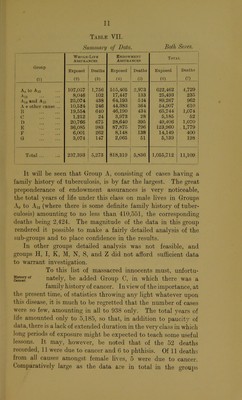
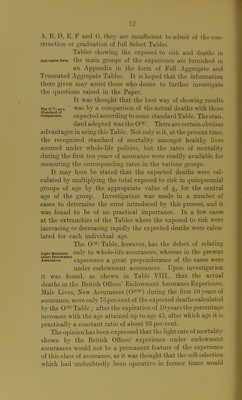
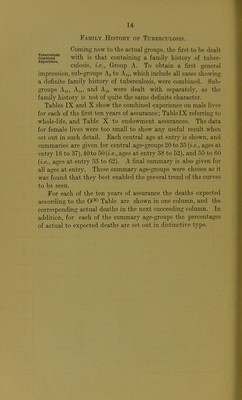
![A, B, D, E, F and G, they are insufficient to admit of the con- struction or graduation of full Select Tables. Tables showing the exposed to risk and deaths in Aggregate Data. the main groups of the experience are furnished in an Appendix in the form of Full Aggregate and Truncated Aggregate Tables. It is hoped that the information there given may assist those who desire to further investigate the questions raised in the Paper. It was thought that the best way of showing results The ocm] as a was by a comparison of the actual deaths with those Standard of _. comparison. expected according to some standard Table. The stan- dard adopted was the 0[Mb There are certain obvious advantages in using this Table. Not only is it, at the present time, the recognized standard of mortality amongst healthy lives assured under whole-life policies, but the rates of mortality during the first ten years of assurance were readily available for measuring the corresponding rates in the various groups. It may here be stated that the expected deaths were cal- culated by multiplying the total exposed to risk in quinquennial groups of age by the appropriate value of qx for the central age of the group. Investigation was made in a number of cases to determine the error introduced by this process, and it was found to be of no practical importance. In a few cases at the extremities of the Tables where the exposed to risk were increasing or decreasing rapidly the expected deaths were calcu- lated for each individual age. The 0[M] Table, however, has the defect of relating Light Mortality only to whole-life assurances, whereas in the present Assurances. experience a great preponderance ot tne cases were under endowment assurances. Upon investigation it was found, as shown in Table VIII., that the actual deaths in the British Offices’ Endowment Assurance Experience, Male Lives, New Assurances (0[EMl) during the first 10 years of assurance, were only 7 5 per-cent of the expected deaths calculated by the 0[M1 Table ; after the expiration of 10 years the percentage increases with the age attained up to age 45, after which age it is practically a constant ratio of about 83 per-cent. The opinion has been expressed that the light rate of mortality shown by the British Offices’ experience under endowment assurances would not be a permanent feature of the experience of this class of assurance, as it was thought that the self-selection which had undoubtedly been operative in former times would](https://iiif.wellcomecollection.org/image/b22439651_0014.jp2/full/800%2C/0/default.jpg)