Volume 1
Alphabetical catalogue of the library, preceded by an index of subjects / by Alexander Duncan.
- Duncan, Alexander.
- Date:
- 1885-1901
Licence: Attribution-NonCommercial 4.0 International (CC BY-NC 4.0)
Credit: Alphabetical catalogue of the library, preceded by an index of subjects / by Alexander Duncan. Source: Wellcome Collection.
Provider: This material has been provided by Royal College of Physicians, London. The original may be consulted at Royal College of Physicians, London.
19/1106
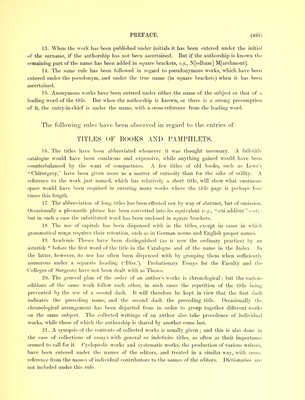
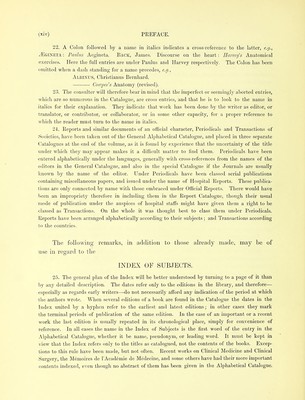
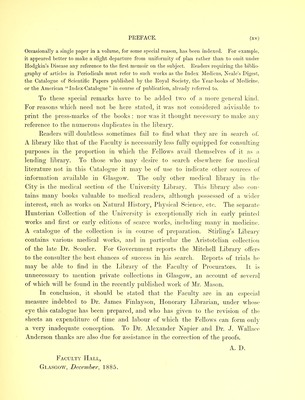
![13. When the work has been published under initials it has been entered under the initial of the surname, if the authorship has not been ascertained. But if the authorship is known the remaining part of the name has been added in square brackets, e.g., N[edham] M[archmont]. 14. The same rule has been followed in regard to pseudonymous works, which have been entered under the pseudonym, and under the true name (in square brackets) when it has been ascertained. 15. Anonymous works have been entered under either the name of the subject or that of a leading word of the title. But when the authorship is known, or there is a strong presumption of it, the entry-in-chief is under the name, with a cross-reference from the leading word. The following rules have been observed in regard to the entries of TITLES OF BOOKS AND PAMPHLETS. 16. The titles have been abbreviated whenever it was thought necessary. A full-title catalogue would have been cumbrous and expensive, while anything gained would have been counterbalanced by the want of compactness. A few titles of old books, such as Lowe's •' Chirurgery, have been given more as a matter of curiosity than for the sake of utility. A reference to the work just named, which has relatively a short title, will show what enormous space would have been required in entering many works where the title page is perhaps four times this length. ] 7. The abbreviation of long titles has been effected not by way of abstract, but of omission. Occasionally a pleonastic phrase has been converted into its equivalent {e.g., cui additur = et) ; but in such a case the substituted word has been enclosed in square brackets. 18. The use of capitals has been dispensed with in the titles, except in cases in which grammatical usage requires their retention, such as in German nouns and English proper names. 19. Academic Theses have been distinguished (as is now the ordinary practice) by an asterisk * before the first word of the title in the Catalogue and of the. name in the Index. In the latter, however, its use has often been dispensed with by grouping them when sufficiently numerous under a separate heading ('Diss.'). Probationary Essays for the Faculty and the Colleges of Surgeons have not been dealt with as Theses. 20. The general plan of the order of an author's works is chronological; but the various editions of the same work follow each other, in such cases the repetition of the title being prevented by the use of a second dash. It will therefore be kept in view that the first dash indicates the preceding name, and the second dash the preceding title. Occasionally the chronological arrangement has been departed from in order to group together different works on the same subject. The collected writings of an author also take precedence of individual works, while those of which the authorship is shared by another come last. 21. A synopsis of the contents of collected works is usually given ; and this is also done in the case of collections of essays with general or indefinite titles, as often as their importance seemed to call for it. Cyclopaedic works and systematic works, the production of various writers, have been entered under the names of the editors, and treated in a similar way, with cross- reference from the names of individual contributors to the names of the editors. Dictionaries arc not included under this rule.](https://iiif.wellcomecollection.org/image/b24750657_0001_0019.jp2/full/800%2C/0/default.jpg)