Volume 1
A system of the anatomy of the human body. Illustrated by upwards of two hundred and fifty tables, taken partly from the most celebrated authors, and partly from nature / By Andrew Fyfe.
- Andrew Fyfe
- Date:
- 1820
Licence: Public Domain Mark
Credit: A system of the anatomy of the human body. Illustrated by upwards of two hundred and fifty tables, taken partly from the most celebrated authors, and partly from nature / By Andrew Fyfe. Source: Wellcome Collection.
85/372
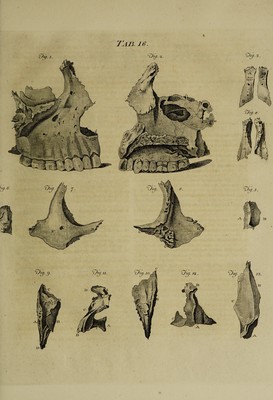
![Part I.] mission of Nerves of the Second Branch of the Fifth Pair, with associate Blood-Vessels, which are the prin¬ cipal Nerves and Vessels of the Palate, lah. VI. 4. A small Hole frequently observed behind the former, and communicating with it, for the passage of a Branch of the Palatine Nerve. Tab. XVI. Fig. 2. o. The Foramen Spheno- Maxillare, Lacerum Infertus, or Inferior Orbitar Fissure, at the under and outer part of the Orbit, and common to the Cuneiform, Maxillary, Malar, and Palate Bones, for lodging Fat belonging to the Eye, and transmitting small Twigs of Vessels and Nerves into the Orbit. The Palate-Plate of this Bone and its Pterygoid Pro¬ cess are firm and strong; but the Nasal Plate and Or¬ bitar Processes are thin and brittle. The connexion of the Os Palati to the Palate-Plate of the Maxillary Bone, by the Transverse Palate Su¬ ture, Tab. VI. before/,—to the Maxillary Bone, at the side of the Nose and bottom of the Orbit, by the Palato-Maxillary Suture, Tab. XVI. Fig. 2. /; t° the Pterygoid Process of the Sphenoid Bone, by the Sphenoid Sutureto the Os Planum and Ethmoid Cells, by the Ethmoid Suture;—and to its fellow, by the Longitudinal Suture. Tab. VI. at the inside of/ The Palate Bone forms part of the Palate, Nose, and Orbit, covers a share of the Ethmoid, Sphenoid, and Maxillary Sinuses, gives origin to part of the Azygos Uvulae, to a portion of the Pterygoideus Externus, and insertion to part of the Circumflexus Palati. In the Foetus, the Palate Bone is complete, but there are no Cells in the Orbitar Processes. Ossa Spongiosa, vel Turbinata Inferiora, Vel CoNCHjE Inferiores. The Situation of each Spongy Bone, projecting m the under part of the side of the Nose. lab. XVII. e- tween q and r. Its triangular form and spongy appearance resem¬ bling the Os Spongiosum Superius. Tab. XVI. Fig. 9. Its convexity towards the Septum Nasi, and concavity outwards. Tab. XVII. Fig. 8. Q. , The under edge placed horizontally near the under part of the Nose, more or less convoluted, ot consider¬ able thickness and strength, and ending in a thin sharp point behind. „ , The two Processes at the upper part ot the Bone, tne anterior ascending and forming part of the Lacryma Groove, and the posterior descending in form ot a Hook, to make part of the side of the Maxillary Sinus, and to contract the opening of that Cavity. a ab. XVI. The Connexion of this Bone to the Os Maxillare, Os Palati, and Os Unguis, by a distinct Suture in the young Subject; but in the Adult, by a concretion of Substance. The Ossa Spongiosa Inferiora afford a large surface for extending the Organ of Smell, by allowing the Mem¬ brane of the Nose to be expanded, upon which the Ol- VOL. I. factory Nerves are dispersed. They form a boundary between the Middle and Inferior Meatus of the Nose, cover the under Orifice of the Lacrymal Canals ; assist also in the formation of these Canals, and of the Orihces of the Maxillary Sinuses. In the Foetus, these Bones are almost complete. Ossa Triangularia, vel Cornua Sphenoidalia. ’Yhe Situation of each triangular Bone between the Bodv of the Sphenoid Bone and root of its internal Ptervo-oid Process, where it covers the under part ot the Sphenoid Sinus. Tab. XIV. Fig. U- Its Connexion to the back part of the Ethmoid Bone. Tab XIV. Fig. 3. k. In an old person, it grows so firmly to the Sphenoid Bone, as to be considered by some Authors as one of its Processes. Vomer. Its Situation in the under part of the Septum Nasi, where it separates the Nostrils from each other, lab. 11 It commonly descends perpendicularly, but it is fre¬ quently bent to one side, in which case the one Nostril is rendered larger than the other. Its Form approaching that of a rhomboid, or it comput ed to that of the Ploughshare, from which it has its name. Tab. XVII. Fig. 2. H. The superior and posterior part, thick and stiong, with a Furrow above to receive the Processus Azygos of the Sphenoid Bone. Tab. XVI. Fig. 13. A. la . XVII. Fig. 2. behind G. . The superior part, with a Groove to receive the Na- sal Plate of the Ethmoid Bone, and the Cartilage of the Nose. Tab. XVII. Fig. 2. before G. The inferior Edge connected with the Spinous Pro¬ cesses of the Palate and Maxillary Bones, by a small Ridge corresponding with a Groove ot these Bones. Tab° XVII. Fig. 2. under H. , , . The posterior-inferior Edge, thick above, but t in and sharp below, unconnected with any other Bone, and turned to the Cavity of the Throat. Tab. XVU. Fig. 2. M!« Tab. VI. g. o i The Vomer has a smooth Surface, and a dense Sub¬ stance, and consists of two Plates in a young person ; but in an old Subject, the Plates are compressed toge¬ ther, so as to render the Bone transparent. It divides the Cavity of the Nose into right and left Nostrils, receives the middle Cartilage of the Nose, ant serves to extend the Olfactory Membranes. Maxilla Inferior. The Figure of the Maxilla Inferior, or Lower Jaw, compared to that of the letter Ui or it forms half of a lono- oval, with the convex middle part forwards. The division into Chin, Sides, and Processes. ^ F](https://iiif.wellcomecollection.org/image/b30455443_0001_0085.jp2/full/800%2C/0/default.jpg)