Volume 1
A system of the anatomy of the human body. Illustrated by upwards of two hundred and fifty tables, taken partly from the most celebrated authors, and partly from nature / By Andrew Fyfe.
- Andrew Fyfe
- Date:
- 1820
Licence: Public Domain Mark
Credit: A system of the anatomy of the human body. Illustrated by upwards of two hundred and fifty tables, taken partly from the most celebrated authors, and partly from nature / By Andrew Fyfe. Source: Wellcome Collection.
88/372
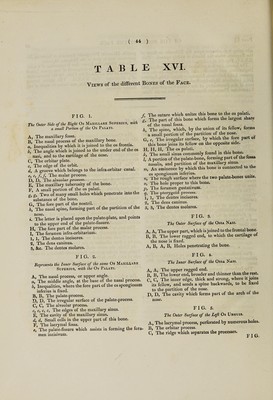
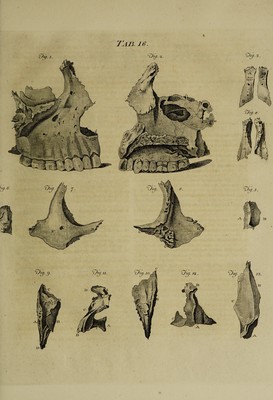
![TABLE XVI. Views of the different Bones of the Face. FIG. 1. The Outer Side of the Right Os Maxillare Superius, with a small Portion of the Os Palati. A, The maxillary fossa. B, The nasal process of the maxillary bone. <z, Inequalities by which it is joined to the os fiontis. h] The angle which is joined to the under end of the os nasi, and to the cartilage of the nose. C, The orbitar plate. c, The edge of the orbit. d} A groove which belongs to the infra-orbitar canal* e, e, f,f, The malar process. J), D, The alveolar process. E, The maxillary tuberosity of the bone. F, A small portion of the os palati. g, g, Two of many small holes which penetrate into the substance of the bone. G, The fore part of the nostril. . . h, The nasal spine, forming part of the partition ol the nose. , i, The letter is placed upon the palate-plate, and points to the upper end of the palate-fissure. H, The fore part of the malar process. I, The foramen infra-orbitarium. 1, 1, The dentes incisores. 2, The dens caninus. 3, &c. The dentes molares. FIG. 2. Represents the Inner Surface of the same Os Maxillare Superius, with the Os Palati. A, The nasal process, or upper angle, a, The middle angle, at the base of the nasal process. by Inequalities, where the fore part of the os spongiosum inferius is fixed. B, B, The palate-process. £)? The irregular surface of the palate-process. C, C, The alveolar process. Cy Cy c, c, The edges of the maxillary sinus. E, The cavity of the maxillary sinus. dy dy Small cells in the upper part of this bone. F, The lacrymal fossa. ty The palate-fissure which assists in forming the fora¬ men incisivum. f The suture which unites this bone to the os palati. g, The part of this bone which forms the largest share of the nasal fossa. # . hy The spine, which, by the union of its fellow, forms ’ a small portion of the partition of the nose. G, e. The irregular surface, by which the fore part of this bone joins its fellow on the opposite side. H, H, H, The os palati. , Jcy The small sinus commonly found in this bone. I, A portion of the palate-bone, forming part of the fossa nasalis, and partition of the maxillary sinus. in, An eminence by which this bone is connected to the os spongiosum inferius. ii. The rough surface where the two palate-bones unite. o, The hole proper to this bone. p, The foramen gustativum. q, The pterygoid process. 1, 1, The dentes incisores. 2, The dens caninus. 3, 3, The dentes molares. FIG. 3. The Outer Surface of the Ossa Nasi. A, A, The upper part, which is joined to the frontal bone. B, B, The lower ragged end, to which the cartilage of the nose is fixed. A, B, A, B, Holes penetrating the bone. FIG. 4. The Inner Surface of the Ossa Nasi. A, A, The upper ragged end. B, B, The lower end, broader and thinner than the rest, c’ C, The inner edge, thick and strong, where it joins ’its fellow, and sends a spine backwards, to be fixed to the partition of the nose. D, D, The cavity which forms part of the arch of the nose. FIG. 5. The Outer Surface of the Left Os Unguis. A, The lacrymal process, perforated by numerous holes. B, The orbitar process. C, The ridge which separates the processes.](https://iiif.wellcomecollection.org/image/b30455443_0001_0088.jp2/full/800%2C/0/default.jpg)