Licence: Public Domain Mark
Credit: Elements of practical pharmacy / by Robert John Kane. Source: Wellcome Collection.
Provider: This material has been provided by The University of Leeds Library. The original may be consulted at The University of Leeds Library.
364/410
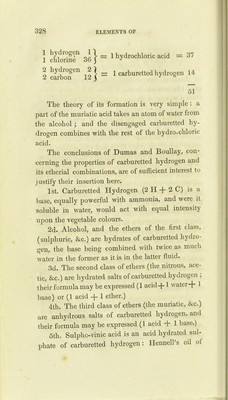
![1 hydrochloric acid = 37 1 carburetted hydrogen 14 51 The theory of its formation is very simple: a part of the muriatic acid takes an atom of water from the alcohol ; and the disengaged carburetted hy- drogen combines with the rest of the hydrochloric acid. The conclusions of Dumas and Boullay, con- cerning the properties of carburetted hydrogen and its etherial combinations, are of sufficient interest to justify their insertion here; 1st. Carburetted Hydrogen (2 H + 2 C) is a base, equally powerful with ammonia, and were it soluble in water, would act with equal intensity upon the vegetable colours. 2d. Alcohol, and the ethers of the first class, (sulphuric, &c.) are hydrates of carburetted hydro- gen, the base being combined with twice as much water in the former as it is in the latter fluid. 3d. The second class of ethers (the nitrous, ace- tic, &c.) are hydrated salts of carburetted hydrogen ; their formula may be expressed (1 acid +1 water + 1 base) or (1 acid + 1 ether.) 4th. The third class of ethers (the muriatic, &c.) are anhydrous salts of carburetted hydrogen, and their formula may be expressed (I acid + 1 base.) 5th. Sulpho-vinic acid is an acid hydrated sul- phate of carburetted hydrogen: Hennell's oil of 1 hydrogen 11 1 chlorine 36 j 2 hydrogen 2 ) _ 2 carbon 12 ] —](https://iiif.wellcomecollection.org/image/b21521323_0364.jp2/full/800%2C/0/default.jpg)