The British Pharmacopoeia and its critics / by Professor Attfield.
- John Attfield
- Date:
- 1885
Licence: Public Domain Mark
Credit: The British Pharmacopoeia and its critics / by Professor Attfield. Source: Wellcome Collection.
Provider: This material has been provided by The Royal College of Surgeons of England. The original may be consulted at The Royal College of Surgeons of England.
3/10
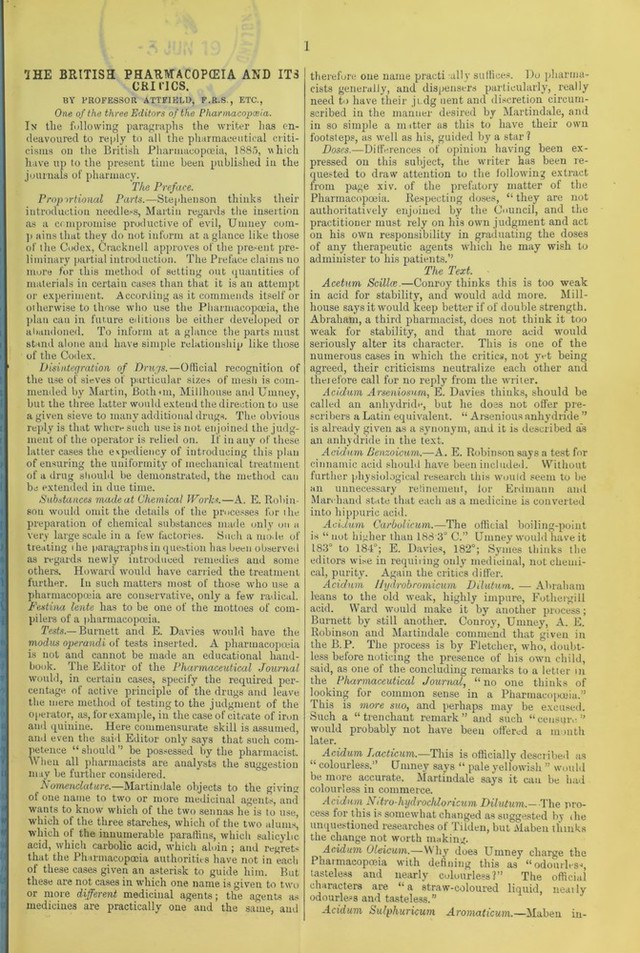
![1HE BRITISH PHARMACOPOEIA AND ITS CRITICS. BY PROFESSOR ATTFIELO, F.R.S., ETC., One of the three Editors of the Pharmacopoeia. In the following paragraphs the writer has en- deavoured to reply to all the pharmaceutical criti- cisms on the British Pharmacopoeia, 1885, which have up to the present time been published in the journals of pharmacy. The Preface. Proportional Parts.—Stephenson thinks their introduction needless, Martin regards the insertion as a compromise productive of evil, Umney com- ]> ains that they do not inform at a glance like those of the Codex, Cracknell approves of the present pre- liminary partial introduction. The Preface claims no more for this method of setting out quantities of materials in certain cases than that it is an attempt or experiment. According as it commends itself or otherwise to those wdio use the Plnirmacopceia, the plan can in future editions be either developed or abandoned. To inform at a glance the parts must stand alone and have simple relationship like those of the Codex. Disintegration of Drugs.—Official recognition of the use of sieves of particular sizes of mesh is com- mended by Martin, Bothtm, Millhouse and Umney, but the three latter would extend the direction to use a given sieve to many additional drugs. The obvious reply is that where such use is not enjoined the judg- ment of the operator is relied on. If in any of these latter cases the expediency of introducing this plan of ensuring the uniformity of mechanical treatment of a drug should be demonstrated, the method can be extended in due time. Substances made at Chemical Works.—A. E. Robin- son would omit the details of the processes for the preparation of chemical substances made only on a very large scale in a few factories. Such a mode of treating ihe paragraphs in question has been observed as regards newly introduced remedies and some others. Howard would have carried the treatment further. In such matters most of those who use a pharmacopoeia are conservative, only a few radical. Festina lente has to be one of the mottoes of com- pilers of a pharmacopoeia. Tests.—Burnett and E. Davies would have the modus operandi of tests inserted. A pharmacopoeia is not and cannot be made an educational hand- book. The Editor of the Pharmaceutical Journal would, in certain cases, specify the required per- centage. of active principle of the drugs and leave the mere method of testing to the judgment of the operator, as, for example, in the case of citrate of iron and quinine. Here commensurate skill is assumed, and even the said Editor only says that such com- petence “should” be possessed by the pharmacist. When all pharmacists are analysts the suggestion may be further considered. Nomenclature.—Martindale objects to the giving of one name to two or more medicinal agents, and wants to know which of the two sennas he is to use, which of the three starches, which of the two alums’ which of the innumerable paraffins, which salicylic acid, which carbolic acid, which aloin ; and regrets that the Pharmacopoeia authorities have not in each of these cases given an asterisk to guide him. But these are not cases in which one name is given to two or more different medicinal agents; the agents as medicines are practically one and the same, and therefore one name practi ally suffices. Do pharma- cists generally, and dispensers particularly, really need to have their ji.dg uent and discretion circum- scribed in the manner desired by Martindale, and in so simple a mutter as this to have their own footsteps, as well as his, guided by a star? Doses.—Differences of opinion having been ex- pressed on this subject, the writer has been re- quested to draw attention to the following extract from page xiv. of the pi’efutory matter of the Pharmacopoeia. Respecting doses, “ they are not authoritatively enjoined by the Council, and the practitioner must rely on his own judgment and act on his own responsibility in graduating the doses of any therapeutic agents which he may wish to administer to his patients.” The Text. Acetum Scillce.—Conroy thinks this is too weak in acid for stability, and would add more. Mill- house says it would keep better if of double strength. Abraham, a third pharmacist, does not think it too weak for stability, and that more acid would seriously alter its character. This is one of the numerous cases in which the critics, not y«T being agreed, their criticisms neutralize each other and tliei efore call for no reply from the writer. Acidum Arseniosum, E. Davies thinks, should be called an anhydride, but he does not offer pre- scribers a Latin equivalent. “ Arsenious anhydride ” is already given as a synonym, and it is described as an anhydride in the text. Acidum Benzoicum.—A. E. Robinson says a test for cinnamic acid should have been included. Without further physiological research this would seem to be an unnecessary refinement, lor Erdmann and Man-hand state that each as a medicine is converted into hippuric acid. Acidum Carbolicum.—The official boiling-point is “ not higher than 188 3° C.” Umney would have it 183° to 184°; E. Davies, 182°; Symes thinks the editors wme in requiring only medicinal, not chemi- cal, purity. Again the critics differ. Acidum Hydrobromicum Dilution. — Abraham leans to the old weak, highly impure, Fothergill acid. Ward would make it by another process; Burnett by still another. Conroy, Umney, A. E. Robinson and Martindale commend that given in the B.P. The process is by Fletcher, who, doubt- less before noticing the presence of his own child, said, as one of the concluding remarks to a letter in the Pharmaceutical Journal, “ no one thinks of looking for common sense in a Pharmacopoeia.” This is more suo, and perhaps may be excused. Such a “ trenchant remark ” and such “ ceusuiv. ” would probably not have been offered a month later. Acidum Lacticum.—This is officially described as “ colourless.” Umney says “ pale yellowish ” would be more accurate. Martindale says it can be had colourless in commerce. Acidum Nitro-hydrochloricum Dilutum.— The pro- cess for this is somewhat changed as suggested by die unquestioned researches of Tifden, but iilaben thinks the change not worth making. Acidum Oleicum.—Why does Umney charge the Pharmacopoeia with defining this as “odourles-, tasteless and nearly colourless?” The official characters are “ a straw-coloured liquid, neai ly odourless and tasteless.” Acidum Sulphuricwn Aromaticum.—Maben in-](https://iiif.wellcomecollection.org/image/b22459248_0005.jp2/full/800%2C/0/default.jpg)