Free thoughts on quacks and their medicines, occasioned by the death of Dr. Goldsmith and Mr. Scawen; or, a candid ... inquiry into the merits and dangers imputed to advertised remedies ... To which is added some remarks on the nature, cause and remedy of the scurvy and gout. Also a plan of the dispensary for the poor, instituted in 1773 / [Francis Spilsbury].
- Spilsbury, Francis, 1733?-1793.
- Date:
- 1777
Licence: Public Domain Mark
Credit: Free thoughts on quacks and their medicines, occasioned by the death of Dr. Goldsmith and Mr. Scawen; or, a candid ... inquiry into the merits and dangers imputed to advertised remedies ... To which is added some remarks on the nature, cause and remedy of the scurvy and gout. Also a plan of the dispensary for the poor, instituted in 1773 / [Francis Spilsbury]. Source: Wellcome Collection.
52/194 page 2
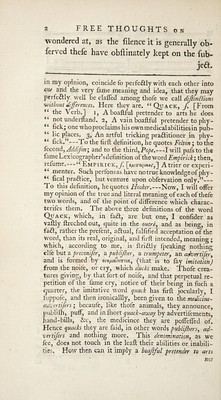
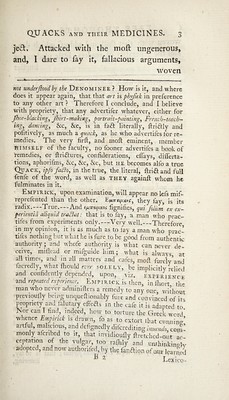
![O N wondered at, as the filence it is generally ob- ferved thefe have obftinately kept on the fub- jeft. ■ — . . • ' • in my opinion, coincide fo perfectly with each other into cut and the very fame meaning and idea, that they may perfe£lly well be clafted among thofe we call dijlindlions without differences. Here they are. u Quack, f [From the Verb.] i, Aboaftful pretender to arts he does not underftand. 2, A vain boaftful pretender to phy- lick; one who proclaims his own medical abilities in pub- lie places. 3, An artful tricking praftitioner in phy- “ fick.”---To the firft definition, he quotes Felton ; to the fecond, Addifon; and to the third, Pope.—I will pafs to the fame Lexicographer’s definition of the word Empirick; then? refume.EMPiRicK,y. Atrieror experi- 44 menter. Such perfons as have no true knowledge of phy- fical praftice, but venture upon obfervation only.”—■- To this definition, he quotes Hooker.—Now, I will offer my opinion of the true and literal meaning of each of thefe two words, and of the point of difference which charac- teriles them. The above three definitions of the word Quack, which, in faft, are but one, I confider as vaftly ftreched out, quite in the outre, and as being, in fa£l, rather the prefent, aftual, falfified acceptation of the word, than its real, original, and firft intended, meaning; which, according to me, is ftriftly fpeaking nothing elfe but a preconifer, a publijher, a trumpeter, an advertifer, and is formed by oro^ctWc/ct, (that is to fay imitation) from the noife, or cry, which clucks make. Thofe crea¬ tures giving, by that fort of noife, and that perpetual re¬ petition of the fame cry, notice of their being in fuch a quarter, the imitative word quack has firft jocularly, I fuppofe, and then ironicallly, been given to the medicine- acivertifers; becaufe, like thofe animals, they announce, publifh, puff, and infhort quack-azuay by advertifements, hand-bills, &c, the medicince they are poflefled of. Hence quacks they are faid, in other words publifhers, ad¬ vert fers and nothing more. Fhis denomination, as we fee, does not touch in the leaft their abilities or inabili¬ ties, How then can it imply a boajiful pretender to arts not](https://iiif.wellcomecollection.org/image/b30509531_0052.jp2/full/800%2C/0/default.jpg)
 No text description is available for this image
 No text description is available for this image
 No text description is available for this image