The constituents of the rhizome of apocynum androsæmifolium / by Charles W. Moore.
- Moore, Charles W.
- Date:
- [1909?]
Licence: In copyright
Credit: The constituents of the rhizome of apocynum androsæmifolium / by Charles W. Moore. Source: Wellcome Collection.
9/22 page 740
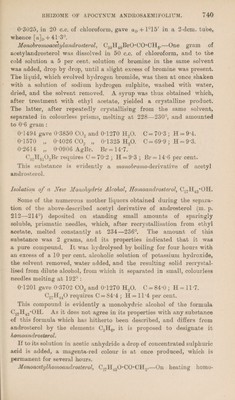
![0'3025, in 20 c.c. of chloroform, gave aD + l°15' in a 2-clcm. tube, -whence [a]D +41 Monohromoacetylandrosterol, Cg^H^gBrO'CC’CHg.—One gram of acetylandrosterol was dissolved in 50 c.c. of chloroform, and to the cold solution a 5 per cent, solution of bromine in the same solvent was added, drop by drop, until a slight excess of bromine was present. The liquid, which evolved hydrogen bromide, was then at once.shaken with a solution of sodium hydrogen sulphite, washed with water, dried, and the solvent removed. A syrup was thus obtained which, after treatment with ethyl acetate, yielded a crystalline product. The latter, after repeatedly crystallising from the same solvent, separated in colourless prisms, melting at 228—230°, and amounted to 0’6 gram : 0T494 gave 0-3850 COo and 0-1270 HoO. C = 70-3; H = 9-4. 0-1570 „ 0-4026 00“ „ 0-1325 HgO. 0 = 69-9; H = 9-3. 0-2614 „ 0-0906 AgBr. Br=14-7. ^32^51^2®^’ 0 = 70-2 ; H = 9-3 ; Br = 14-6 per cent. This substance is evidently a ?^o?io6ro??io-derivative of acetyl androsterol. Isolation of a Xew Monohydric Alcohol^ Homoandrosterol^ 027^43*011. Some of the numerous mother liquors obtained during the separa¬ tion of the above-described acetyl derivative of androsterol (m. p. 212—214°) deposited on standing small amounts of sparingly soluble, prismatic needles, which, after recrystallisation from ethyl acetate, melted constantly at 234—236°. The amount of this substance was 2 grams, and its properties indicated that it was a pure compound. It was hydrolysed by boiling for four hours with an excess of a 10 per cent, alcoholic solution of potassium hydroxide, the solvent removed, water added, and the resulting solid recrystal¬ lised from dilute alcohol, from which it separated in small, colourless needles melting at 192° : 0-1201 gave 0-3702 COg and 0-1270 HgO. C = 84-0; H=ll-7. C27H44O requires C = 84*4 ; H = 11 -4 per cent. This compound is evidently a monohydric alcohol of the formula C27H43*0H. As it does not agree in its properties with any substance of this formula which has hitherto been described, and differs from androsterol by the elements CgHg, it is proposed to designate it hamoandrosterol. If to its solution in acetic anhydride a drop of concentrated sulphuric acid is added, a magenta-red colour is at once produced, which is permanent for several hours. Monoacetylhomoandrosterol, Co7H430*C0*CH3.—On heating homo-](https://iiif.wellcomecollection.org/image/b30614387_0009.jp2/full/800%2C/0/default.jpg)