Some derivatives of umbellulone / by Frederic H. Lees.
- Lees, F. H. (Frederic Herbert)
- Date:
- [1904.]
Licence: In copyright
Credit: Some derivatives of umbellulone / by Frederic H. Lees. Source: Wellcome Collection.
8/12 page 644
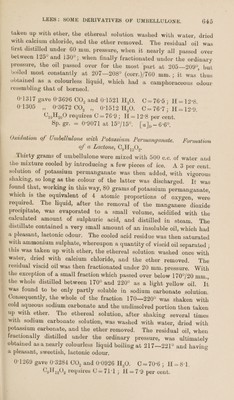
![A solution containing 0*5232 gram in 25 c.c. of chloroform gave ar) + 0°8' in a 1 dm. tube, whence [a]D + 6*4°. Dibromodihydroumbellulone can also be conveniently recrystallised from hot ethyl alcohol; it separates from the solution on cooling in glistening, prismatic needles. It is a saturated substance, since its solution in chloroform containing bromine can be boiled without the colour of the latter becoming discharged. It is also very stable towards boiling nitric acid, for its bromine is not eliminated on boiling with this reagent in the presence of silver nitrate. It does not inter¬ act with hydroxylamine even in boiling alcoholic solution. Bromodihydroumbellulone, C10H15OBr. Twenty grams of dibromodihydroumbellulone were dissolved in 100 c.c. of glacial acetic acid, and 40 grams of zinc dust added. The mixture was heated on a water-bath during five hours, and then ground up with more glacial acetic acid. The insoluble mixture of zinc salts was then removed by filtration at the pump, and the bromo- derivative precipitated from the filtrate by the addition of water. The crystalline precipitate, when washed, and dried on a porous plate, weighed 13 grams, and then melted at 58—59°. It was recrystallised from dilute methyl alcohol, from which it separated in well-defined, transparent, prismatic needles melting at 58—59°. 0*2042 gave 0*3885 C02 and 0*1181 H20. C = 51*9; H = 6*4. 0*2046 „ 0*3912 C02 „ 0*1224 H20. C = 52*1 ; H = 6*6. C10H15OBr requires C = 51*9 3 H = 6*5 per cent. A solution containing 0*4163 gram in 25 c.c. of chloroform gave aD - 1°1 O' in a 1 dm. tube, whence [a]D — 70*1°. Bromodihydroumbellulone is readily soluble in cold ethyl and methyl alcohols, ethyl acetate, benzene, chloroform, and petroleum. When it is melted and warmed somewhat, its vapour has an odour resembling that of a-bromocamphor. It is a saturated substance, since its solution in chloroform containing bromine can be boiled without decolorising the latter. Like the dibromo-derivative, bromo¬ dihydroumbellulone does not interact with hydroxylamine. Tetrahydroumbellulol, C10H19*OIT. Thirteen grams of bromodihydroumbellulone were dissolved in 150 c.c. of ethyl alcohol, and 10 grams of sodium gradually introduced in small pieces. The solution was not cooled, but was allowed to boil vigorously. When all the sodium had dissolved, the liquid was cooled and diluted with water in order to precipitate the oil, which was then](https://iiif.wellcomecollection.org/image/b30606597_0008.jp2/full/800%2C/0/default.jpg)




 No text description is available for this image
 No text description is available for this image
 No text description is available for this image