Some derivatives of umbellulone / by Frederic H. Lees.
- Lees, F. H. (Frederic Herbert)
- Date:
- [1904.]
Licence: In copyright
Credit: Some derivatives of umbellulone / by Frederic H. Lees. Source: Wellcome Collection.
9/12 page 645
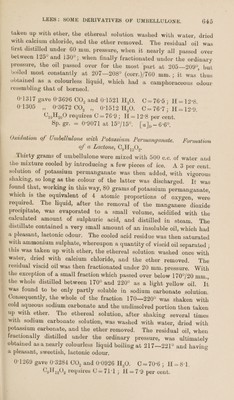
![takeu up with ether, the ethereal solution washed with water, dried with calcium chloride, and the ether removed. The residual oil was first distilled under 60 mm. pressure, when it nearly all passed over between 125Jand 130J; when finally fractionated under the ordinary pressure, the oil passed over for the most part at 205_209°, but boiled most constantly at 207—208° (corr.)/760 mm.; it was’thus obtained as a colourless liquid, which had a camphoraceous odour resembling that of borneol. 0*1317 gave 0*3696 C02 and 0*1521 H20. C = 76*5; H=12-8. 0 1305 „ 0*3672 C02 „ 0*1512 H20. C = 76*7; H = 12*9. ^10^20^ requires C = 76*9 ; H = 12*8 per cent. Sp. gr. = 0-9071 at 15°/15°. [a]D-6*6°. Oxidation of Umbellulone with Potassium Permanganate. Formation of a Lactone, C9H1202. Thirty grams of umbellulone were mixed with 500 c.c. of water aud the mixture cooled by introducing a few pieces of ice. A 3 per cent, solution of potassium permanganate was then added, with vigorous shaking, so long as the colour of the latter was discharged. It was found that, working in this way, 80 grams of potassium permanganate, which is the equivalent of 4 atomic proportions of oxygen, were required. The liquid, after the removal of the manganese dioxide precipitate, was evaporated to a small volume, acidified with the calculated amount of sulphuric acid, and distilled in steam. The distillate contained a very small amount of an insoluble oil, which had a pleasant, lactonic odour. The cooled acid residue was then saturated with ammonium sulphate, whereupon a quantity of viscid oil separated ; this was taken up with ether, the ethereal solution washed once with water, dried with calcium chloride, and the ether removed. The residual viscid oil was then fractionated under 20 mm. pressure. With the exception of a small fraction which passed over below 170°/20 mm., the whole distilled between 170° and 220° as a light yellow oil. It was found to be only partly soluble in sodium carbonate solution. Consequently, the whole of the fraction 170—220° was shaken with cold aqueous sodium carbonate and the undissolved portion then taken up with ether. I he ethereal solution, after shaking several times with sodium carbonate solution, was washed with water, dried with potassium carbonate, and the ether removed. The residual oil, when tract ion ally distilled under the ordinary pressure, was ultimately obtained as a nearly colourless liquid boiling at 217—221° and having a pleasant, sweetish, lactonic odour. 0*1269 gave 0*3284 C02 and 0*0926 H2G. C = 70*6 ; II = 8*1.](https://iiif.wellcomecollection.org/image/b30606597_0009.jp2/full/800%2C/0/default.jpg)




 No text description is available for this image
 No text description is available for this image
 No text description is available for this image