The Oxyrhynchus papyri. Part 2 / edited with translations and notes by Bernard P. Grenfell and Arthur S. Hunt.
- Date:
- 1899
Licence: Public Domain Mark
Credit: The Oxyrhynchus papyri. Part 2 / edited with translations and notes by Bernard P. Grenfell and Arthur S. Hunt. Source: Wellcome Collection.
40/398 page 18
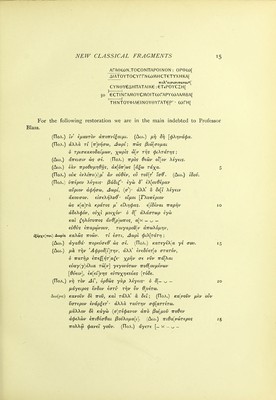
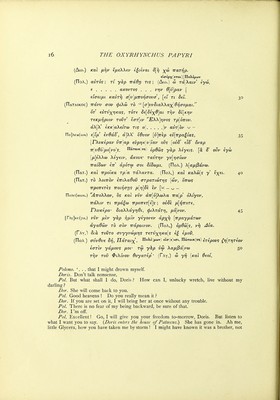
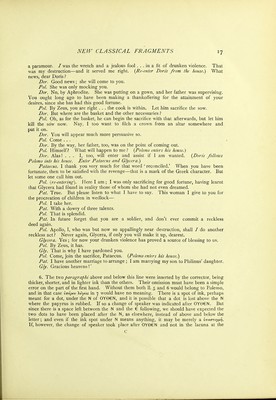
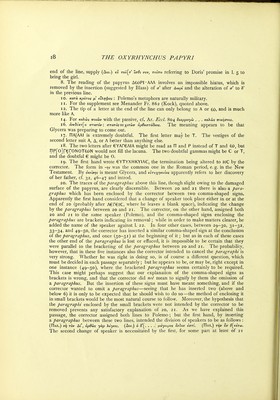
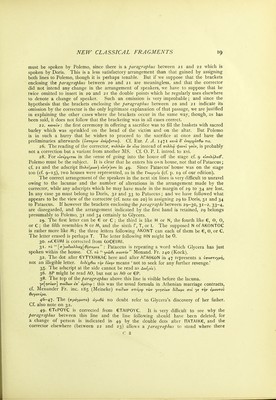
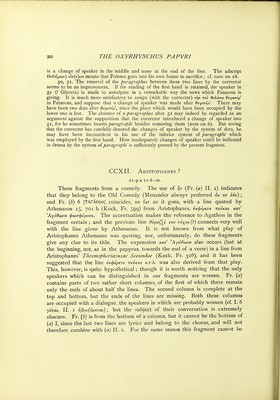
![end of the line, supply (Δω.) fv τοί[τ' 'ίσθι vw, τοΐιτο referring to Doris' promise in 1. 5 to bring the girl. 8. The reading of the papyrus Δ60ΡΓΑΛΛ involves an impossible hiatus, which is removed by the insertion (suggested by Blass) of σ after Λωρί and the alteration of σ to δ' in the previous line. 10. κατά κράτος μ' ('ίληφαε : Polemo's metaphors are naturally military. 11. For the supplement see Menander Fr. 862 (Kock), quoted above. 12. The tip of a letter at the end of the line can only belong to A or 00, and is much more like A. 14. For καλώς ποιων with the passive, cf. Ar. Eccl. 804 διαρραγώ . . . καλώς ποιήσεις. 16. eVSu6r[o στατόν. στατός=χιτων όρθοστάδιος. The meaning appears to be that Glycera was preparing to come out. 17. TTA[AAI is extremely doubtful. The first letter maybe T. The vestiges of the second letter suit Α, Δ, or Λ better than anything else. 18. The two letters after €ΥΑΓ€ΛΙΑ might be read as TT and Ρ instead of Τ and CO, but ΠΡ[θ]Γ€ΓΟΝΟΤ60Ν would not fill the lacuna. The two doubtful gammas might be C or T, and the doubtful € might be 0. 19. The first hand wrote 6YTYXHKYIAC, the termination being altered to HC by the corrector. The form in -ης was the common one in the Roman period, e. g. in the New Testament. By έκΰνης is meant Glycera, and εντνχηκνίας apparently refers to her discovery of her father, cf. 32, 46-47 and introd. 20. The traces of the paragraphia above this line, though slight owing to the damaged surface of the papyrus, are clearly discernible. Between 20 and 21 there is also a para- graphias which has been enclosed by the corrector between two comma-shaped signs. Apparently the first hand considered that a change of speaker took place either in or at the end of 20 (probably after Λ6Γ€Ι0, where he leaves a blank space), indicating the change by the paragraphus between 20 and 21. The corrector, on the other hand, assigned both 20 and 21 to the same speaker (Polemo), and the comma-shaped signs enclosing the paragraphus are brackets indicating its removal; while in order to make matters clearer, he added the name of the speaker against 1. 22. In four other cases, between 29-30, 31-32, 33-34, and 49-50, the corrector has inserted a similar comma-shaped sign at the conclusion of the paragraphus, and once (50-51) at the beginning of it; but as in each of these cases the other end of the paragraphus is lost or effaced, it is impossible to be certain that they were parallel to the bracketing of the paragraphus between 20 and 21. The probability, however, that in these five instances also the corrector intended to cancel the paragraphi is very strong. Whether he was right in doing so, is of course a different question, which must be decided in each passage separately; but he appears to be, or may be, right except in one instance (49-50), where the bracketed paragraphus seems certainly to be required. This case might perhaps suggest that our explanation of the comma-shaped signs as brackets is wrong, and that the corrector did not mean to signify by them the omission of a paragraphus. But the insertion of these signs must have meant something, and if the corrector wanted to omit a paragraphus—seeing that he has inserted two (above and below 6) it is only to be expected that he should wish to do so—the method of enclosing it in small brackets would be the most natural course to follow. Moreover, the hypothesis that the paragraphi enclosed by the small brackets were not intended by the corrector to be removed prevents any satisfactory explanation of 20, 21. As we have explained this passage, the corrector assigned both lines to Polemo ; but the first hand, by inserting a paragraphus between these two lines, intended the division of speakers to be as follows : (ΤΤολ.) vr\ τον Αί', ορθώς γαρ λέγεις. (Δω.) ό δ'[. . . ,'| μάγειρος ένδον εστί. (Πολ.) την νν θ[νίτω. The second change of speaker is necessitated by the first, for some part at least of 21](https://iiif.wellcomecollection.org/image/b21782933_0040.jp2/full/800%2C/0/default.jpg)
 No text description is available for this image
 No text description is available for this image
 No text description is available for this image