The Oxyrhynchus papyri. Part 2 / edited with translations and notes by Bernard P. Grenfell and Arthur S. Hunt.
- Date:
- 1899
Licence: Public Domain Mark
Credit: The Oxyrhynchus papyri. Part 2 / edited with translations and notes by Bernard P. Grenfell and Arthur S. Hunt. Source: Wellcome Collection.
42/398 page 20
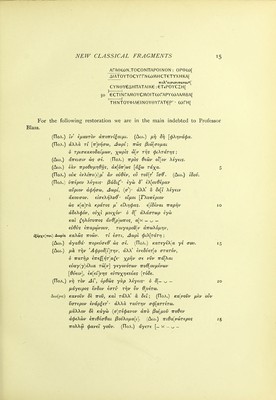
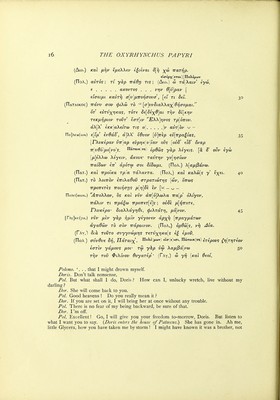
![is a change of speaker in the middle and none at the end of the line. The adscript Πολε'(μωι/) ΐ'ίσ{ΐ)ισί means that Polemo goes into his own house to sacrifice; cf. note on 28. 50, 51. The removal of the paragraphus between these two lines by the corrector seems to be an improvement. If the reading of the first hand is retained, the speaker in 51 (? Glycera) is made to anticipate in a remarkable way the news which Pataecus is giving. It is much more satisfactory to assign (with the corrector) την τοΰ Φιλίνου θνγατίρ to Pataecus, and suppose that a change of speaker was made after θυγατίρ'. There may have been two dots after βυγατίρ\ since the place which would have been occupied by the lower one is lost. The absence of a paragraphus after 51 may indeed be regarded as an argument against the supposition that the corrector introduced a change of speaker into 51, for he sometimes inserts paragraph! besides removing them (note on 6). But seeing that the corrector has carefully denoted the changes of speaker by the system of dots, he may have been inconsistent in his use of the inferior system of paragraphi which was employed by the first hand. How inadequately changes of speaker could be indicated in drama by the system of paragraphi is sufficiently proved by the present fragment. CCXII. Aristophanes ? 219 χ π·6 cm. Three fragments from a comedy. The use of fjv (Fr. (a) II. 2) indicates that they belong to the Old Comedy (Menander always preferred av or edv); and Fr. (b) 6 ]ΤΑΓΑθ(χ)[ coincides, so far as it goes, with a line quoted by Athenaeus 15, 701 b (Kock, Fr. 599) from Aristophanes, έκφέρπε ttcvkols κατ Αγάθωνα φωσφόρους. The accentuation makes the reference to Agathon in the fragment certain ; and the previous line θύραζ[ξ νυν τάχος (?) connects very well with the line given by Athenaeus. It is not known from what play of Aristophanes Athenaeus was quoting, nor, unfortunately, do these fragments give any clue to its title. The expression κατ Αγάθωνα also occurs (but at the beginning, not, as in the papyrus, towards the end of a verse) in a line from Aristophanes' Thesmophoriazusae Secundae (Kock, Fr. 326), and it has been suggested that the line Ικφίρζτζ τκύκας κ.τ.λ. was also derived from that play. This, however, is quite hypothetical ; though it is worth noticing that the only speakers which can be distinguished in our fragments are women. Fr. (a) contains parts of two rather short columns, of the first of which there remain only the ends of about half the lines. The second column is complete at the top and bottom, but the ends of the lines are missing. Both these columns are occupied with a dialogue, the speakers in which are probably women (cf. I. 6 γύναι, II. ι υβριζόμξναι); but the subject of their conversation is extremely obscure. Fr. (b) is from the bottom of a column, but it cannot be the bottom of (a) I, since the last two lines are lyrics and belong to the chorus, and will not therefore combine with (a) II. 1. For the same reason this fragment cannot be](https://iiif.wellcomecollection.org/image/b21782933_0042.jp2/full/800%2C/0/default.jpg)
 No text description is available for this image
 No text description is available for this image
 No text description is available for this image