The Oxyrhynchus papyri. Part 2 / edited with translations and notes by Bernard P. Grenfell and Arthur S. Hunt.
- Date:
- 1899
Licence: Public Domain Mark
Credit: The Oxyrhynchus papyri. Part 2 / edited with translations and notes by Bernard P. Grenfell and Arthur S. Hunt. Source: Wellcome Collection.
46/398 page 24
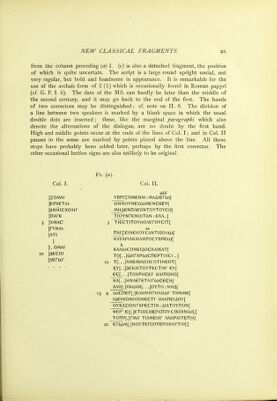
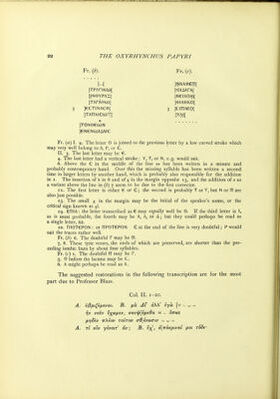
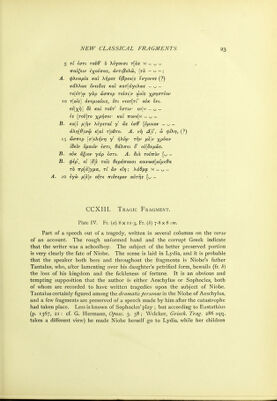
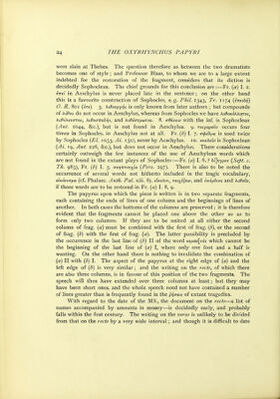
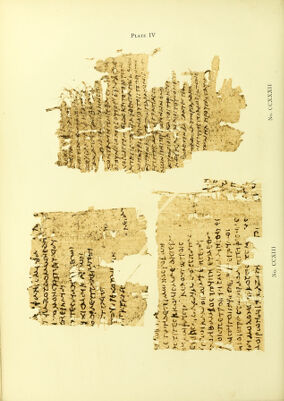
![were slain at Thebes. The question therefore as between the two dramatists becomes one of style ; and Professor Blass, to whom we are to a large extent indebted for the restoration of the fragment, considers that its diction is decidedly Sophoclean. The chief grounds for this conclusion are:—Fr. (a) I. 2. €7ret in Aeschylus is never placed late in the sentence; on the other hand this is a favourite construction of Sophocles, e.g. Phil. 1343, Tr. 1174 (euei5?j) 0. R. 801 (ore). 3. λιθονργής is only known from later authors ; but compounds of λίθος do not occur in Aeschylus, whereas from Sophocles we have λιθοκόλλητος, λιθόλ^νστος, λίθοσπαδής, and λίθόστρωτος. 8. σθίν^ιν with the inf. is Sophoclean (Ant. 1044, &c), but is not found in Aeschylus. 9. τοιγαροΰν occurs four times in Sophocles, in Aeschylus not at all. Fr. (b) I. 7. σφόδρα is used twice by Sophocles (El. 1053, Ai. 150), never by Aeschylus. 10. κνκλύν is Sophoclean (At. 19, Ant. 226, &c), but does not occur in Aeschylus. These considerations certainly outweigh the few instances of the use of Aeschylean words which are not found in the extant plays of Sophocles:—Fr. (a) I. 6. ? οί]νγρος (Sept. c. Th. 985), Fr. (b) I. 3. σκηπτονχία (Pers. 297). There is also to be noted the occurrence of several words not hitherto included in the tragic vocabulary, (Ικόνισμα (cf. Phalaec. Anth. Pal. xiii. 6), euciAos, τξΐχίζίΐν, and άκάρδιοί and λιθονν, if those words are to be restored in Fr. (a) I. 8, 9. The papyrus upon which the piece is written is in two separate fragments, each containing the ends of lines of one column and the beginnings of lines of another. In both cases the bottoms of the columns are preserved ; it is therefore evident that the fragments cannot be placed one above the other so as to form only two columns. If they are to be united at all either the second column of frag, (a) must be combined with the first of frag, (b), or the second of frag, (b) with the first of frag. (a). The latter possibility is precluded by the occurrence in the last line of (b) II of the word Ktpav\y0s which cannot be the beginning of the last line of (a) I, where only one foot and a half is wanting. On the other hand there is nothing to invalidate the combination of (a) II with (b) I. The aspect of the papyrus at the right edge of (a) and the left edge of (b) is very similar ; and the writing on the recto, of which there are also three columns, is in favour of this position of the two fragments. The speech will then have extended over three columns at least; but they may have been short ones, and the whole speech need not have contained a number of lines greater than is frequently found in the ρήσςις of extant tragedies. With regard to the date of the MS., the document on the recto—a list of names accompanied by amounts in money—is decidedly early, and probably falls within the first century. The writing on the verso is unlikely to be divided from that on the recto by a very wide interval; and though it is difficult to date](https://iiif.wellcomecollection.org/image/b21782933_0046.jp2/full/800%2C/0/default.jpg)

 No text description is available for this image
 No text description is available for this image
 No text description is available for this image