Quadrupeds: or, outlines of a popular history of the class mammalia; with a particular notice of those mentioned in Scripture.
- Religious Tract Society
- Date:
- 1840
Licence: Public Domain Mark
Credit: Quadrupeds: or, outlines of a popular history of the class mammalia; with a particular notice of those mentioned in Scripture. Source: Wellcome Collection.
31/176 (page 19)
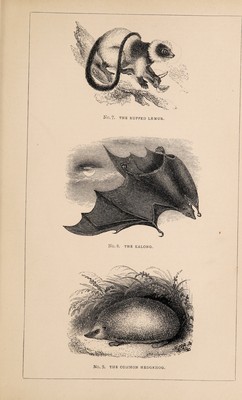
![CARNIVORA.] a full -white ruff, or tuft, surrounds the face. In its habits and disposition it is similar to its congeners. Closing the series of quadrumanous animals are several genera which have been confounded by earlier writers with that of the true Lemurs ; but from which they are now rightly separated, not only because they differ as it respects the coun¬ tries they inhabit, but because they exhibit mark¬ ed generic characteristics. They are nocturnal animals, pursuing their food, which consists of insects and small animals, solely during the night. Their eyes are extremely large, and adapted to their habits. The day is passed in profound sleep, from which they rouse as the dusk comes on, to begin to search for their prey The genus termed Loris, Geoff., or Stenops, III CErevuQ, contracted, and ’'Qi//, countenance,] which is characterized by shortness of muzzle, want of tail, and roughness of tongue, includes, among a few other species, that very singular ani¬ mal the Lori, or Slow Lemur, a native of Bengal, where it is called in Malay the Poucan. Of all animals the Lori is one of the most slo-w and indolent, creeping along with an air of difficulty and constraint. It seems, however, not altogether devoid of intelligence, and may be partially tamed. L’Obsonville, who kept one in his possession, says, that “at the approach of night it would rub its eyes, then, looking attentively on all sides, would walk over the furniture, or, rather, over the cords which I had disposed for that purpose. Milk and very ripe fruits were not disagreeable to it; but its chief food consisted of insects or small birds. If it perceived any thing of this kind, which I used to amuse myself by placing at the extremity of the room, it would approach with a lengthened circumspect pace, like one who was groping his way in the dark. Ar¬ rived within about a foot of its prey, it would stop, then raising itself upright, would advance in that posture, stretching out its arms gently, and would suddenly seize the object, which it instantly strangled.” In size the slow Lori is equal to a lemur, being fifteen or sixteen inches in length ; its fur is short, and of a yellowish grey, with a brown stripe along the back. The Gallagos form another singular tribe of animals, and are peculiar to Africa. Their habits are nocturnal; their eyes large ; and their food insects and birds. Their hinder limbs are very long; their tail long and tufted; and they jump with extreme agility. The ear is large, mem¬ branous, and naked; and its powers are highly acute. According to Adamson, their manners are those of monkeys and squirrels, perching among the foliage of trees, where they pursue their insect food, which they take with the hand. They make their nests like squirrels in the branches of trees, and cover a bed of grass and leaves for their little ones. With the natives of Senegal they are an article of food: they abound in the gum-tree forests of the deserts of Sahara, and are caught by the Moors, and brought to Europeans on the coast for sale. They are there called “ the animals of the gum.” When sleeping, the Gallago closes its ears, by folding down the external membrane, but opens them on the slightest noise. It is a pretty, gentle animal; the length of the body is about seven inches, that of the tail nine^ We here close our sketch of this order, having traced it reeeding from the orang by successive steps, until those prominent features which marked it at its outset become softened down as it were in the distance. But in tracing it thus step by step we have only done half our work, if we have forgotten Him whose mighty wisdom conceived the plan, and bade all spring into life out of nothing; all the harmonies of nature; all the accordances of being; and those endless grades which constitute a chain, returning as a circle into itself, and forming one great whole. “ These are thy works. Parent of good!” But these are not all his works in which we are interested; in the plan of redemption God not only displays his wisdom and power, but his love and mercy. “ In this was manifested the love of God toward us, because that God sent his only begotten Son into the world, that we might live through Him,” 1 John iv. 9. Reader, think on this God of power and love, and then on yourself, “ What is man that Thou art mindful of him? and the son of man that Thou visitest him ?” ORDER III.—CARNIVORA. Extremities four; neither in this nor in the succeeding orders is there a thumb free and antagonising with fingers, and consequently no true hands; teeth of three kinds. The third order of Mammalia, is that compre¬ hending the Carnassiers, {Carnivora,') or ani¬ mals whose appetite is more or less exclusively carnivorous. The great tribes into which this order is divided differ considerably in their habits and manners, and present a group much less united by simili¬ tude, much less bound together by strongly marked features pervading every subdivision, than we have found obtaining among the previ¬ ous quadrumanous order. Some, like the bird, are expressly formed for flight, while, on the con¬ trary, others tenant the sea, and prey upon the finny tribes of the waters. Although the circumstance of living upon the flesh of other animals is one of the chief peculi¬ arities of this order, and one from which it de¬ rives its generic title, still it must be taken to a certain degree in a limited sense only; for, in one family at least, we find the diet to consist in a great measure of vegetable substances, to which flesh is only added occasionally. The differences in habits and structure which occur in this order prevent the possibility of arranging the genera in a line perfectly unbroken and uniform, but rather conduce to their distribution into families branch¬ ing out from a common centre, and connected among themselves by various and multiform ties of relationship. We do not, however, mean to say by this observation, that there are no grounds which the order can occupy as a common resting- place : on the contrary, its title is established, and its boundaries are fixed by natural limits, which it is impossible to mistake. In defining the char¬ acters of this order we may state, that the teeth](https://iiif.wellcomecollection.org/image/b29293005_0031.jp2/full/800%2C/0/default.jpg)