Quadrupeds: or, outlines of a popular history of the class mammalia; with a particular notice of those mentioned in Scripture.
- Religious Tract Society
- Date:
- 1840
Licence: Public Domain Mark
Credit: Quadrupeds: or, outlines of a popular history of the class mammalia; with a particular notice of those mentioned in Scripture. Source: Wellcome Collection.
35/176 (page 21)
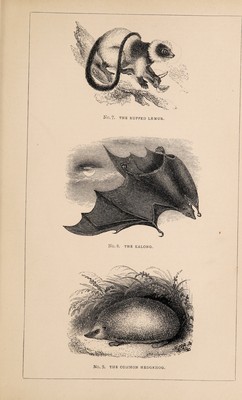
![1-----: CARNIVOKA.] BATS—THE KALONG. 21 j lie shall utterly abolish: and they shall go into holes of the rocks, and into the caves of the earth, for fear of the Lord, and for the glory of his majesty, -when he ariseth to shake terribly the earth. In that day a man shall cast his idols of silver, and his idols of gold, which they made each one for himself to worship, to the moles and to the hats.” When the inspired writers of the sacred volume avail themselves of the objects of nature, either in illustration of their subject, or in connexion with it, we cannot fail to he struck, however ca¬ sual or slight the allusion may be, with a philo¬ sophic correctness, which is hardly overstepped even when that allusion is clothed in the elevated diction of poetry. The Bat was well known throughout Syria; and the crevices, the lonely caverns, and sepul- j chres in the rocks around Jerusalem fur¬ nished in the days of old, as in the present, a secluded hiding-place. One idea, therefore, which the inspired writer designed to convey was that of neglect and loneliness: their idols should be consigned to oblivion, their temples to ruin ; man should forsake them, and the seclusion-lov¬ ing hat should make the halls, once thronged with idolatrous worshippers, its solitary abode ; or the idols should be cast out of every house and temple, and thrown among the caves and desolate places of the rocks, where even their memory should be lost. Another idea was that of disgust or contempt. The hat, by the Jewish laws, was accounted unclean, and consequently held in abhorrence : it was unfit for food ; it was no welcome guest in Judea : to consign the idols to the bats, therefore, implied aversion, degra¬ dation, and reproach. Hence we see that the pro¬ phet used no random expression, hut the most striking and appropriate which he could possi¬ bly have selected, and one the force of which a Jew would have felt in its fullest m.eaning. The Jewish dispensation, fettered with cere¬ monies and observances heavy to be borne, has been happily abrogated by a better dispensation promulgated by the blessed Messiah, whose “ yoke is easy,” and whose “ burden is light.” To us, therefore, the bat is no foul thing of dark- 1 ness, but an interesting little animal, associated with recollections of summer-eve, and peace, and quiet hours of contemplation. Who cannot re¬ trace—who does not love to retrace the walk by “ woods, and lawns, and living stream at eve,” when the toils of the day and the hurry of busi¬ ness are over ? At such a time, while all around breathes of the beneficence of the Great Creator, and the calm repose of the hour blending with . the rural harmony of the scene has awakened trains of thought absorbing every feeling of the soul, how often has this little plunderer, uttering its shrill scream as it has wheeled rapidly round our head, broken in upon our musings, and in¬ terrupted our train of reflection ! and yet it is a favourite: the old trees, the river, the antique farm-house, the cool sequestered lane require its presence at the twilight hour to make the charm complete. It is but within a few years that naturalists have paid much attention to this singular family, and consequently the number of species correctly made out has been but very limited. Fifteen or 1 sixteen different species indigenous in Great Bri- ! tain are now, however, known; these are refer- | able to three different genera, namely, Mhinolo- phus, distinguished by leaf-like membranes on the nose ; VespertiJio, of which our common bat is the example ; and Plecotus, embracing such as have large expanding ears. In general habits and manners they all agree, but they differ as to the periods of hybernation and activity. The Pipistrelle, a common hat, (Vespertillo pipistrel- lus) appears earlier in the year, and retires later than qny other; the great bat, ( V. noctula,) sel¬ dom appears before the end of April, and retires in August. In that delightful book. White’s “ Natural History of Selborne,” we find the fol¬ lowing sketch, which we take the liberty of pre¬ senting to our readers. He says, “ I was much entertained last summer with a tame bat, which would take flies out of a person’s hand. If you gave it any thing to eat, it brought its wings round before the mouth, hovering and hiding its head, in the manner of birds of prey when they feed. The adroitness it showed in shearing otf the wings of the flies, which were always re¬ jected, was worthy of observation, and pleased me much. Insects seemed to be most acceptable, though it did not refuse raw flesh when offered ; so that the notion that bats go down chimneys and gnaw the bacon, seems no improbable story. While I amused myself with this wonderful qua¬ druped, I saw it several times confute the vulgar opinion, that bats when down on a flat surface cannot get on the wing again, by rising with great ease from the floor. It ran, I observed, with more ease than I was aware of, but in a most ridiculous and grotesque manner. Bats drink on the wing, like swallows, by sipping the surface as they play over pools and streams. They love to frequent waters not only for the sake of drinking, but on account of insects which are found over them in the greatest plenty. As I was going some years ago, pretty late, in a boat from Richmond to Sunbury, on a warm summer’s evening, I think I saw myriads of bats between the tv>^o places ; the air swarmed with them all along the Thames, so that hundreds were in sight at a time.” To persons accustomed only to our British bats, the size of some of the foreign species must appear a little startling. Among the Moussettes, or fruit-eating bats, {Pteropus,') all distinguish¬ able for their great extent of wing, we may no¬ tice a species described by Dr. Horsfield, as the Kalong, (^Pteropus Javanicus,') which that emi¬ nent naturalist considers as the largest of the genus hitherto discovered. “ In adult subjects the extent of the expanded wings is full five feet, and the length of the body one foot.” The Kalong {See Engraving, No. 8,) is ex¬ tremely abundant in the lower parts of Java, but does not visit the elevated districts. Numerous in¬ dividuals, often in companies to the amount of se¬ veral hundreds, fix upon a tree for their roosting- place, where suspended in rows and clusters by their hinder claws, with their heads hanging down¬ wards, and their wings folded round them, they exhibit a singular spectacle. A species of ficus, often growing near the villages, is a very favour¬ ite retreat. During the day they are in general](https://iiif.wellcomecollection.org/image/b29293005_0035.jp2/full/800%2C/0/default.jpg)