Report of the Director-General of Public Health, New South Wales.
- New South Wales. Department of Public Health
- Date:
- [1930]
Licence: Public Domain Mark
Credit: Report of the Director-General of Public Health, New South Wales. Source: Wellcome Collection.
176/180 page 132
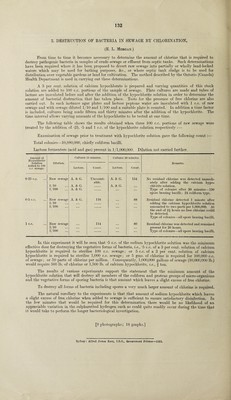
![3. DESTRUCTION OF BACTERIA IN SEWAGE BY CHLORINATION. (E. L. Morgan.) From time to time it becomes necessary to determine the amount of chlorine that is required to destroy pathogenic bacteria in samples of crude sewage or effluent from septic tanks. Such determinations have been required where it has been proposed to divert raw sewage into partially or wholly land-locked waters which may be used for bathing purposes, &c., or where septic tank sludge is to be used for distribution over vegetable gardens or land for cultivation. The method described by the Ontario (Canada) Health Department is used in carrying out these determinations. A 3 per cent, solution of calcium hvpochlorate is prepared and varying quantities of this stock solution are added to 100 c.c. portions of the sample of sewage. Plate cultures are made and tubes of lactose are inoculated before and after the addition of the hypochlorite solution in order to determine the amount of bacterial destruction that has taken place. Tests for the presence of free chlorine are also carried out. In each instance agar plates and lactose peptone water are inoculated with 1 c.c. of raw sewage and with sewage diluted 1/10 and 1/100 and a suitable plate is counted. In addition a time factor is included, cultures being made fifteen and thirty minutes after the addition of the hypochlorite. The time interval allows varying amounts of the hypochlorite to be tested at one time. The following table shows the results obtained when three 100 c.c. portions of raw sewage were treated by the addition of -25, -5 and 1 c.c. of the hypochlorite solution respectively :— Examination of sewage prior to treatment with hypochlorite solution gave the following count :— Total colonies—10,880,000, chiefly coliform bacilli. Lactose fermenters (acid and gas) present in 1/1,000,000. Dilution not carried further. Amount of Hypoclilorite Dilution. Cultures 15 minutes. Cultures 30 minutes. Solution Added to 100 c.c. sewage. Lactose. Count. Lactose. Count. Remarks. 025 c.c. Raw sewage A. & G. Uncount¬ able. A. & G. 154 No residual chlorine was detected immedi¬ ately after adding the calcium hypo- 1/10 A. & G. A. & G. • • • chlorite solution. 1/100 A. & G. ... ... Type of colonies after 30 minutes—130 spore bearing bacilli; 24 coliform type. 0-5 c.c. Raw sewage A. & G. 116 ... 88 Residual chlorine detected 1 minute after 1/10 ... ... ... adding the calcium hypochlorite solution 1/100 amounted to two parts per 1,000,000. At the end of 2 £ hours no free chlorine could be detected. Type of colonies-—all spore bearing bacilli. 1 c.c. Raw sewage • • • 114 80 Residual chlorine was detected and remained 1/10 ... • •• • •• present for 20 hours. 1/100 ... ... ... Type of colonies—all spore bearing bacilli. In this experiment it will be seen that -5 c.c. of the sodium hypochlorite solution was the minimum effective dose for destroying the vegetative forms of bacteria, i.e., *5 c.c. of a 3 per cent, solution of calcium hypochlorite is required to sterilise 100 c.c. sewage; or 5 c.c. of a 3 per cent, solution of calcium hypochlorite is required to sterilise 1,000 c.c. sewage; or 5 gms. of chlorine is required for 100,000 c.c. of sewage; or 50 parts of chlorine per million. Consequently, 1,000,000 gallons of sewage (10,000,000 lb.) would require 500 lb. of'chlorine or 1,500 lb. of calcium hypochlorite, i.e., § ton. The results of various experiments support the statement that the minimum amount of the hypochlorite solution that will destroy all members of the coliform and proteus groups of micro-organisms and the vegetative forms of sporing bacteria is that amount which leaves a slight excess of free chlorine. To destroy all forms of bacteria including spores a very much larger amount of chlorine is required. The natural corollary to the experiments is that that amount of sodium hypochlorite which leaves a slight excess of free chlorine when added to sewage is sufficient to ensure satisfactory disinfection. In the few minutes that would be required for this determination there would be no likelihood of an appreciable variation in the sulphuretted hydrogen such as could quite readily occur during the time that i t would take to perform the longer bacteriological investigation. [8 photographs; 16 graphs.] Sydney: Alfred James Kent, I.S.O., Government Printer—1931.](https://iiif.wellcomecollection.org/image/b31485212_0176.jp2/full/800%2C/0/default.jpg)




 No text description is available for this image
 No text description is available for this image
 No text description is available for this image