Views of the microscopic world : designed for general reading, and as a hand-book for classes in natural science / by John Brocklesby.
- John Brocklesby
- Date:
- 1851
Licence: Public Domain Mark
Credit: Views of the microscopic world : designed for general reading, and as a hand-book for classes in natural science / by John Brocklesby. Source: Wellcome Collection.
Provider: This material has been provided by the Francis A. Countway Library of Medicine, through the Medical Heritage Library. The original may be consulted at the Francis A. Countway Library of Medicine, Harvard Medical School.
41/218 (page 31)
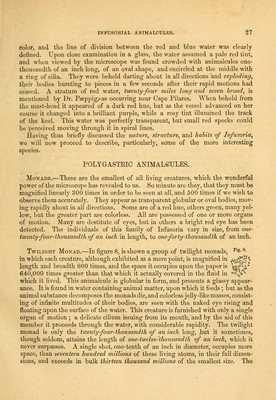
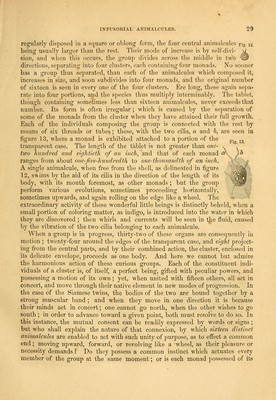
![tinctly discerned fringing its surface. Within the globe a number of smalkf globes are perceived; and these lead us to-^consider the extraordinary manner in which these curious groups are multiplied. They increase by a voluntary separa- tion: from time to time new spherical clusters are thrown off from the original globe; not, however, from its outer surface, into the surrounding water, but from the inner swi-face] into the space enclosed by the transparent shell. Six or eight of these spherical groups are usually found within the parent globe; though, at times, as many as twenty have been seen at once, with their forms well defined, and their color of a bright green. Openings exist, both in the primary sphere and in the interior globes, through which water passes and repasses for the purpose of affording the animalcules fresh supplies of air and food. As the young globes increase in size, the surrounding envelope expands, and as soon as they have attained a certain degree of maturity, it bursts asunder and permits them to escape, Now, uncontrolled in tkeir motions, they range through a wider field of existence, and soon a new generation of revolving monads issues from their parting spheres ; to become, in their turn, the parents of other globes, and so on in a countless series. Fig. 15. This process of increase is exhibited in figure 15, where the offspring are shown issuing from the parent sphere, and within each of the smaller globes another incipient race of re- volving animalcules is detected. The full sized globes are one-thirtieth of an inch in diameter, and the size of the small- est, when liberated from the parent, is one-three hundred and sixtieth of an inch. In figure 16, is delineated a portion of a globe w^itb five single animalcules and a cluster of six young ones at a; they are all attached to the spherical case, and to each other, and the bands which connect them together, as well as their respective organs of motion, are distinctly seen. In figure 1T, a single monad of a revolving globe, sepa- rated from its case, is magnified ttvo thousand times; or, in other words, covers upon the paper a space four mil- lion times greater than its natural extent. In this threads at c, c, c, c, c, c, and the eye of the animalcule, which is of a bright red, is situated at d. The natural size of a single animalcule, is the thirty-five hundredth -part of an inch. The revolving globe is a common spe- cies of Infusoria, and is easily found in the clear shallow waters of brooks and ponds.](https://iiif.wellcomecollection.org/image/b21043723_0041.jp2/full/800%2C/0/default.jpg)