Volume 2
Contributions to Fox ethnology / Truman Michelson.
- Truman Michelson
- Date:
- 1927-30
Licence: Attribution-NonCommercial 4.0 International (CC BY-NC 4.0)
Credit: Contributions to Fox ethnology / Truman Michelson. Source: Wellcome Collection.
174/200 page 160
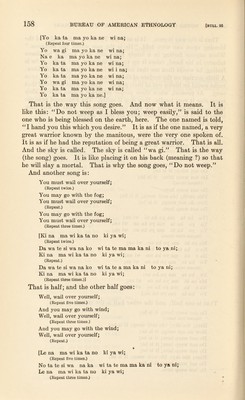
![The spirit of warfare and death; He probably has listened to me. [Ne le se ta ko to ke; (Repeat three times.) Ma ni me no ta na ni ki wi la ki se na ka; Ne le se ta ko to ke; (Repeat three times.) Ma ni me no ta na ni ki wi la ki se na ka; Ne le se ta ko to ke.] That is how one song goes. Now, as to what it signifies and what it means in saying Me na le wa i ki wi la ki se na ka (“Spirit of War¬ fare and Death”; literally, he who goes about dispensing menale wai). There is a single manitou who has control of battle and death. He is the very one (who controls) me na le wa i. “He is the very one who has probably heard me, for he probably knows why I go about wailing and what I desire.” It is exactly as if (this) single manitou is told, “You probably know why I go about wailing.” That is what it means. Then the second half. It is as if he were told what is desired. “The Spirit of Warfare and Death (ma ni me no ta na ni ki wi la ki se na ka; literally, he who goes about dispensing warfare), probably has listened to me,” is what he is told. He, indeed, is the very one who controls mortals so that they will continue to slay each other. Verily he is the very one who goes about dispensing strife (me no ta a ni, more literally, the foe from without); he is the very one who is the Spirit of War (ma ne se no a), and the Spirit of Battle (mi ka ti we ne a) ; he is the one who commands the people to fight against each other. It is as if he were asked to give the people to be slain. He is the very one named in the song. Suppose some one were to go off and fast. If he were to use the song which goes “He probably has heard me,” he surely would be heard, and he would be blessed in whatever way he desired. That is, if he fasted. If he merely used the song, no. Only if he fasted would it happen so. And also if (some one) died. If he were to think, “Perhaps my child has been dealt with foully,” if he had a child; if he were to think, “Perhaps my child has been slain by a witch (ne na ka we si ni tti ni),” then he should use that song. But only if he fasted. Then he should use it in a lonely spot, casting tobacco for Mother-of-all-the-earth, and giving Him-whose-face-bulges-in-the-smoke-hole a smoke. As soon as he has scattered tobacco for them he should cry out. Surely the one by whom his child was slain, destroyed, would die. It is as if the Spirit of Warfare (ne na e ne ta ka me di ka twi, literally, he who controls warfare) would kill him. And that is called warfare (me di ka twi). Battle (mi ka ti we ni) is the same. And the Spirit of War (? possibly, to judge from the syntax, an error for war) is the](https://iiif.wellcomecollection.org/image/b29828004_0002_0174.jp2/full/800%2C/0/default.jpg)




 No text description is available for this image
 No text description is available for this image
 No text description is available for this image