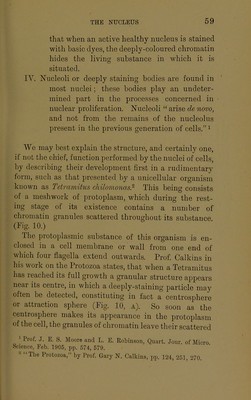
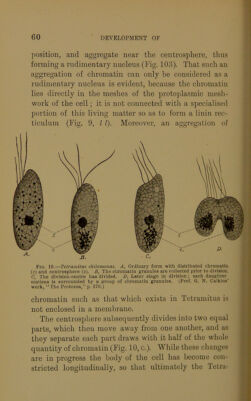
Human speech : a study in the purposive action of living matter / by N.C. Macnamara.
- Nottidge Charles Macnamara
- Date:
- 1908
Licence: In copyright
Credit: Human speech : a study in the purposive action of living matter / by N.C. Macnamara. Source: Wellcome Collection.
108/318 (page 78)
![PSYCHICAL LIFE suppose that, like life itself, it is the result of a peculiar organisation and combination of elements which already pre-exist along with the primitive elements which con- stitute life. On the other hand, these primitive mental elements are not themselves consciousness, as we understand it, any more than inorganic elements in themselves are life. The psychical life of universal matter is not therefore a real and actual life, but merely a “latent life,” which manifests itself under certain conditions. These conditions do not appear to tally with those of life itself, for plants which are liv- ing organisms are endowed with no real psychical life. It may easily be imagined to what an infinitesimal degree the psychic life must he reduced in those beings in which hardly any differentiation of organs and functions exists, though we already find in them, in an extremely simple form, the three fundamental elements of psychical life; to wit—sensation, feeling, and wdll. The evolution of consciousness proceeds jiari passih with the biological organism. In both cases a homogeneous and incoherent whole becomes gradually complex and differentiated.^ Professor A. Bain is one of the ablest exponents of the doctrine of parallelism, which holds that physical and psychical life form two parallel currents, or in his own words, “ the only tenable supposition is that mental and physical proceed together as undivided twins.” - From this, we hope pardonable digression we must ^ “ Contemporary Psychology,” by Guido Villa, lecturer on Philo- sophy in the University of Rome. Translated into English by Harold Manacorda. 2 “ Mind and Body” (ninth edition), by Alexander Bain, LL.U., p. 130. International Scientific Series. See also in the same series, A. Binet on “Mind and the Brain,” ])p. 211, 243, 216.](https://iiif.wellcomecollection.org/image/b28111333_0108.jp2/full/800%2C/0/default.jpg)