Pathological and practical researches on diseases of the brain and the spinal cord / by John Abercrombie.
- Date:
- 1845
Licence: Public Domain Mark
Credit: Pathological and practical researches on diseases of the brain and the spinal cord / by John Abercrombie. Source: Wellcome Collection.
Provider: This material has been provided by the Royal College of Physicians of Edinburgh. The original may be consulted at the Royal College of Physicians of Edinburgh.
383/488 page 359
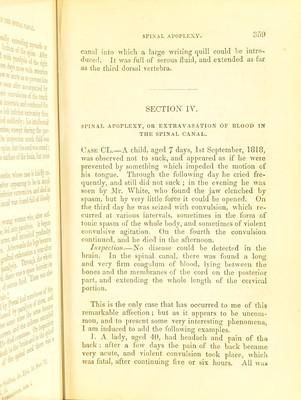
![' .'^'” saoffifariid Iv ''''’onviiliionsofthetrack It intfrTas,aDdcon&iidt(t «Wt inferiot «timiu iktn '.edsiidddy.liisinteliectiial wii?. eicept daring the par- )n inspection mnch fiuidwi ! I csnrfaceoftliehiaiii.lntiiMe onih'. whose case is hritflyK- ariet anpeannsto beinmch ;niWiwestiemii:cSi®'f^‘“l , ate [j legal 1 nadiBl'y JVV*- aiafiet whole istils of the canal into avliicb a large ■writing quill could be intro- ducer]. It avas full of serous fluid, and extended as far as the third dorsal vertebra. SECTION IV. SPINAL APOPLEXY, OR EXTRAVASATION OF BLOOD IN THE spinal canal. Case CL.—A child, aged 7 days, 1st September, 1818, was observed not to suck, and appeared as if he were prevented by something which impeded the motion of his tongue. Through the following day he cried fre- quently, and still did not suck ; in the evening he was seen by Mr. White, who found the jaw clenched by spasm, but by very little force it could be opened. On the third day he was seized with convulsion, which re- curred at various intervals, sometimes in the form of tonic spasm of the whole body, and sometimes of violent convulsive agitation. On the fourth the convulsion continued, and he died in the afternoon. Inspection.—No disease could be detected in the brain. In the spinal canal, there was found a long and very firm coagulum of blood, lying between the bones and the membranes of the cord on the posterior part, and extending the whole length of the cervical portion. This is the only case that has occurred to me of this remarkable affection ; but as it appears to be uncom- mon, and to present some very interesting phenomena, I am induced to add the following examples. 1. A lady, aged 40, had hcadach and pain of tho back ; after a few days the pain of the back became very acute, and violent convulsion took place, which was fatal, after continuing five or six hours. All was](https://iiif.wellcomecollection.org/image/b21959432_0383.jp2/full/800%2C/0/default.jpg)